
FinzData Research · Published 20 October 2026
Das Auto under siege: how China, tariffs and electric rivals are squeezing Germany's carmakers, brand by brand
German car exports are down €9bn this year, China has fallen from the No. 3 market to No. 9, and Tesla and BYD are taking share at home. We take Volkswagen, Audi, Porsche, BMW, MINI and Mercedes-Benz one by one, using customs data since 1988, Q3 2026 deliveries, margins and share prices, and test whether the trade data predicts German stocks.
Get FinzData research free, every morning
The daily brief: what moved, the macro releases that matter, positioning and liquidity, with charts. One email a day, free, unsubscribe anytime.
Contents
- €9bn of car exports gone in seven months
- The €165bn peak (2023) is behind us
- One in every seven euros Germany exports is a car or a car part
- China: from Germany's No. 3 car market to No. 9
- The traffic has reversed: Chinese EVs now flow into Germany
- Tariffs took a third off US sales. The rebound has started
- Winners and losers: the EU holds, China and the Gulf collapse
- The diesel era is over: plug-ins are 39% of car exports
- Electric cars: exports slip, imports surge
- Q3 2026: China is where the volume went
- Brand scorecard: only MINI is growing
- Porsche: the 911 is the last growth engine
- BMW: a China problem, an electric answer
- Mercedes-Benz: electric sales boom, China does not
- At home, Tesla and the Chinese brands are taking share
- VW's China profit engine has nearly stalled
- Profits and jobs are following volumes down
- The market's verdict: carmakers down a third, trucks up
- Trade data tells you what happened, not what is next
- Our read: a structural squeeze, not a bad year
- What to watch
- The data behind this deck
- Frequently asked questions
1. Das Auto Under Siege

FinzData Research, October 2026.
Cars are Germany's biggest export industry. This paper measures what China, US tariffs and the switch to electric are doing to it, using Eurostat's customs data for Germany since 1988 (by destination, by powertrain and for parts, in the FinzData store), the VDA's monthly production and export counts, the third-quarter delivery releases of Volkswagen, BMW and Mercedes-Benz, and daily share prices. It is the companion to our Korea and Taiwan export papers.
2. €9bn of car exports gone in seven months
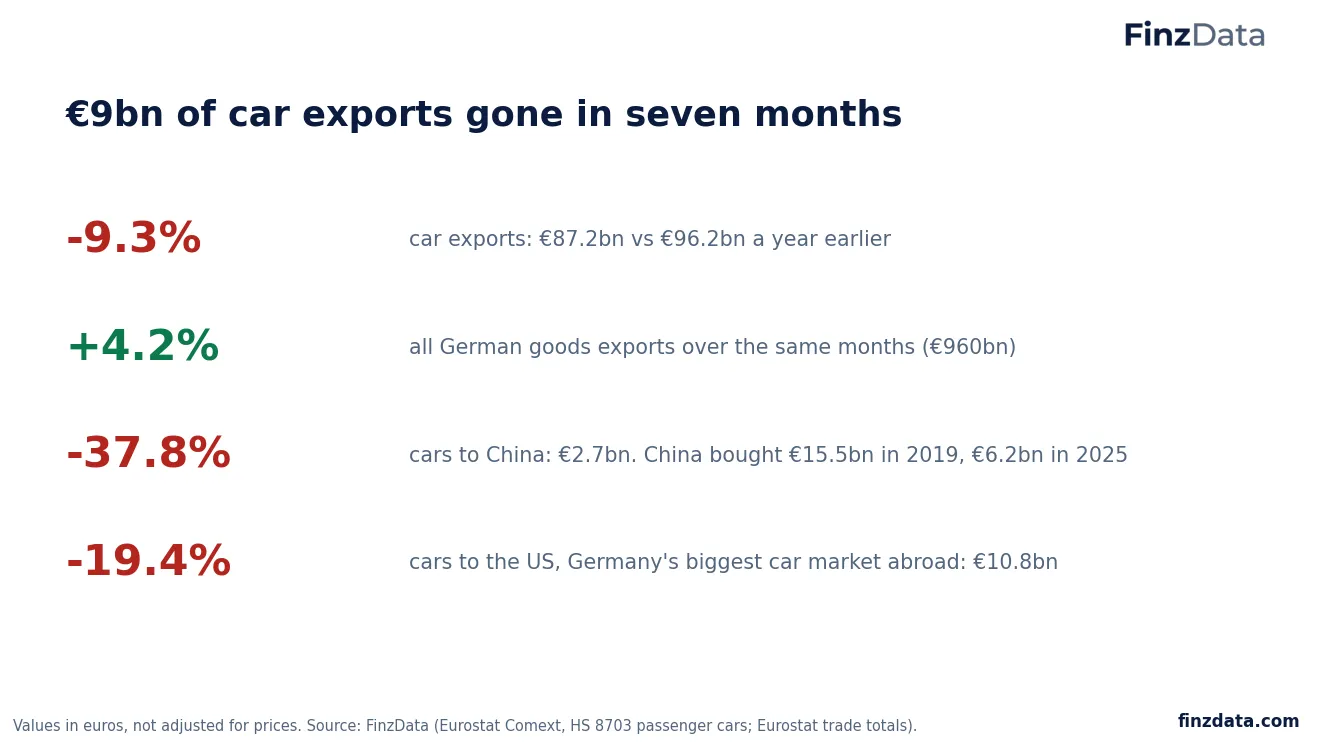
January to July 2026 vs the same months of 2025, in euros.
In the first seven months of 2026 Germany exported €87.2 billion of passenger cars, -9.3% on a year earlier, while all its goods exports rose +4.2%. Cars to China fell -37.8% to €2.7 billion and cars to the United States fell -19.4% to €10.8 billion. The VDA's unit counts agree: production 3.03 million and exports 2.29 million in January-September, both down 4%.
3. The €165bn peak (2023) is behind us
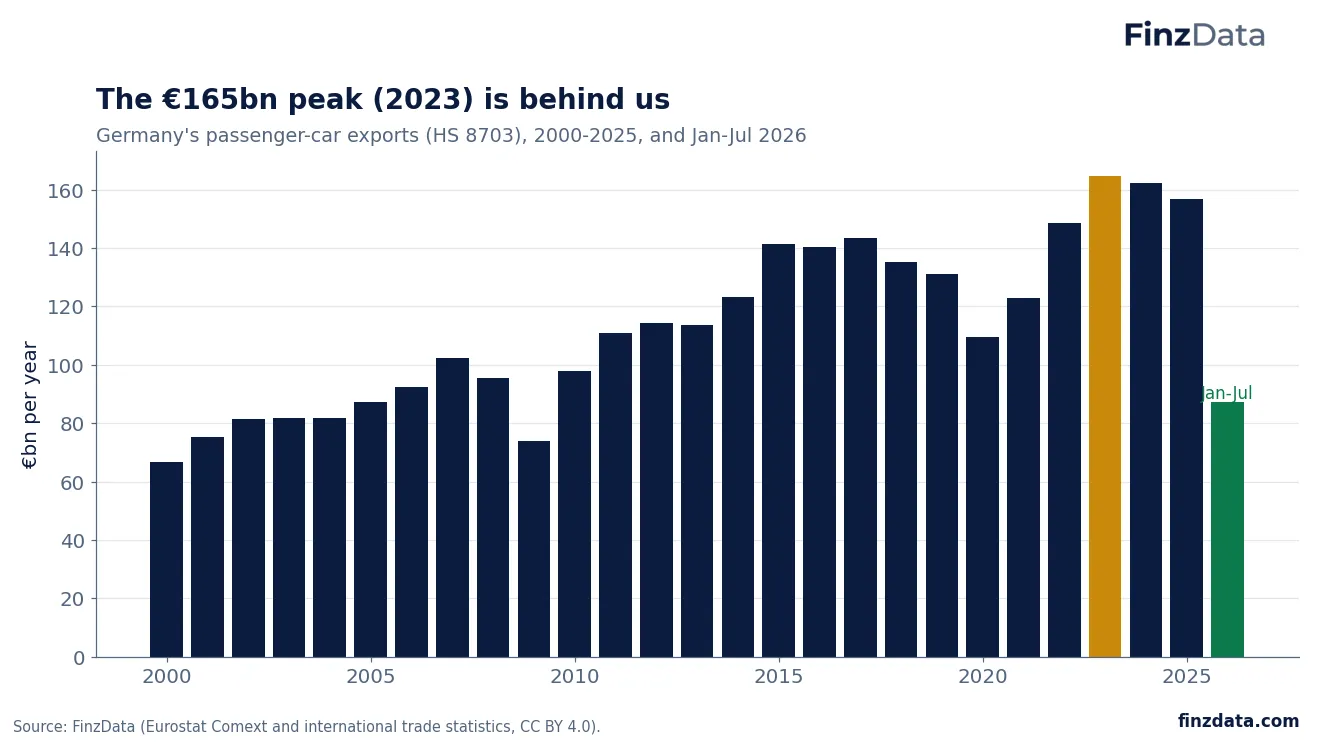
Passenger-car exports (HS 8703), 2000-2025 and January-July 2026.
Car exports rose from €67 billion in 2000 to a peak of €165 billion in 2023, as higher-priced models and electric cars lifted the value per car. They slipped to €162 billion in 2024 and €157 billion in 2025. In units the decline started earlier: the VDA counts 3.17 million cars exported in 2025, 9% below 2019.
4. One in every seven euros Germany exports is a car or a car part
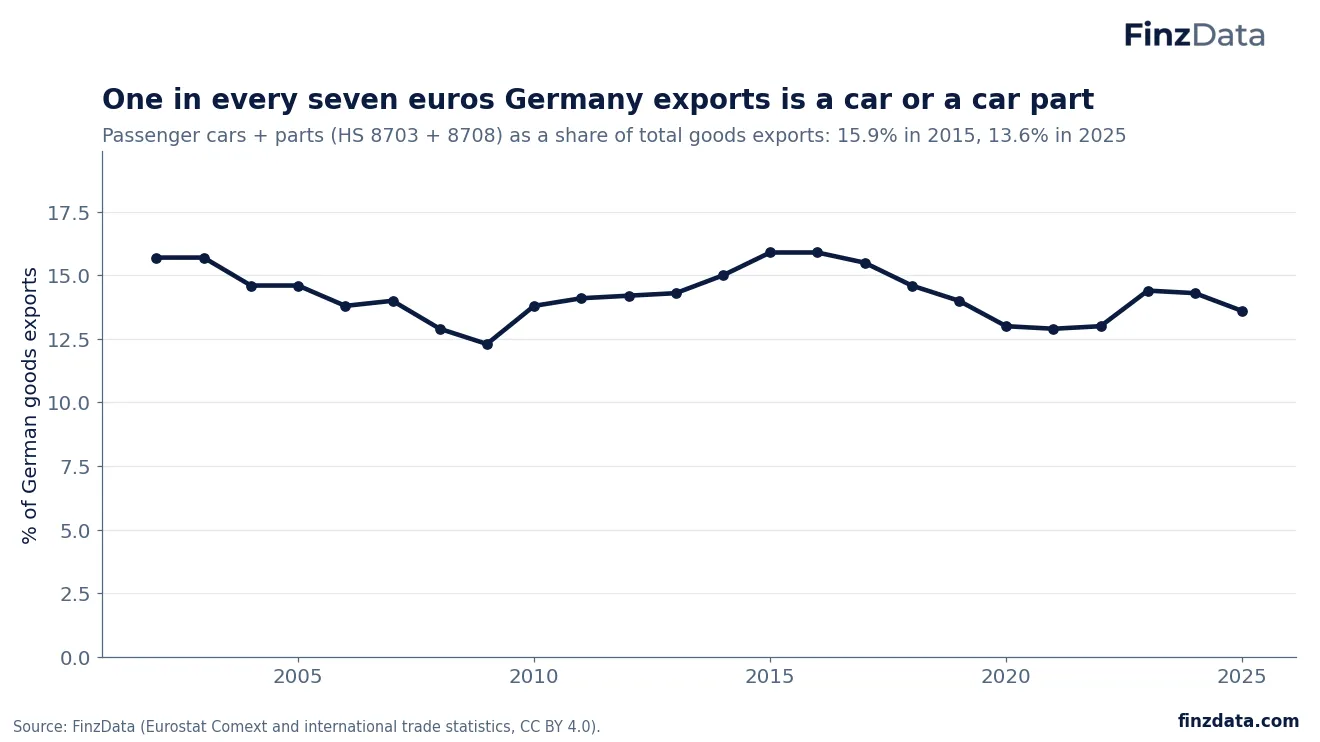
Passenger cars plus parts as a share of all German goods exports.
Cars plus parts were 15.9% of German goods exports in 2015 and 13.6% in 2025: still about one euro in seven. That is why a weak car year shows up in Germany's trade balance, its industrial output and the DAX.
5. China: from Germany's No. 3 car market to No. 9
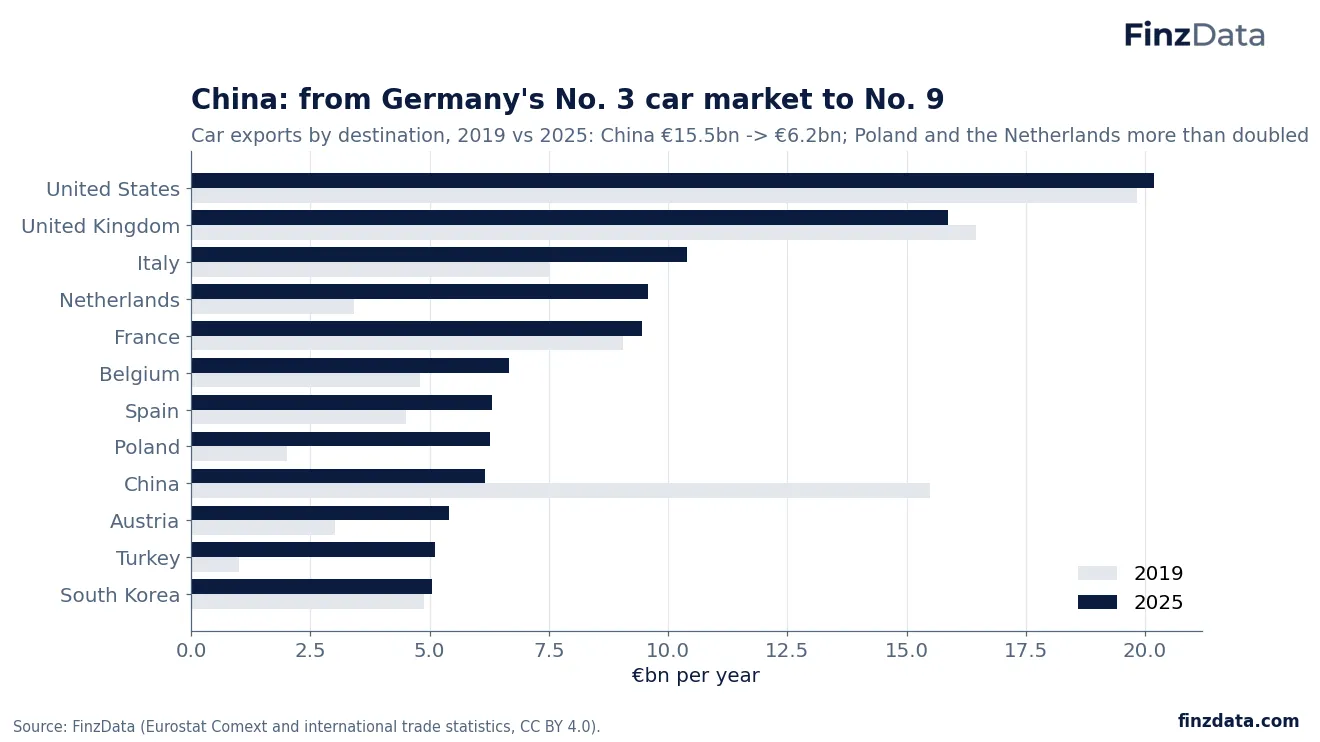
Car exports by destination, 2019 vs 2025.
In 2019 the United States (€19.8 billion), the United Kingdom (€16.4 billion) and China (€15.5 billion) were Germany's three biggest car markets abroad. By 2025 China had dropped to €6.2 billion, ninth, behind Italy, the Netherlands, France, Belgium, Spain and Poland. Exports to Poland and the Netherlands more than doubled.
6. The traffic has reversed: Chinese EVs now flow into Germany
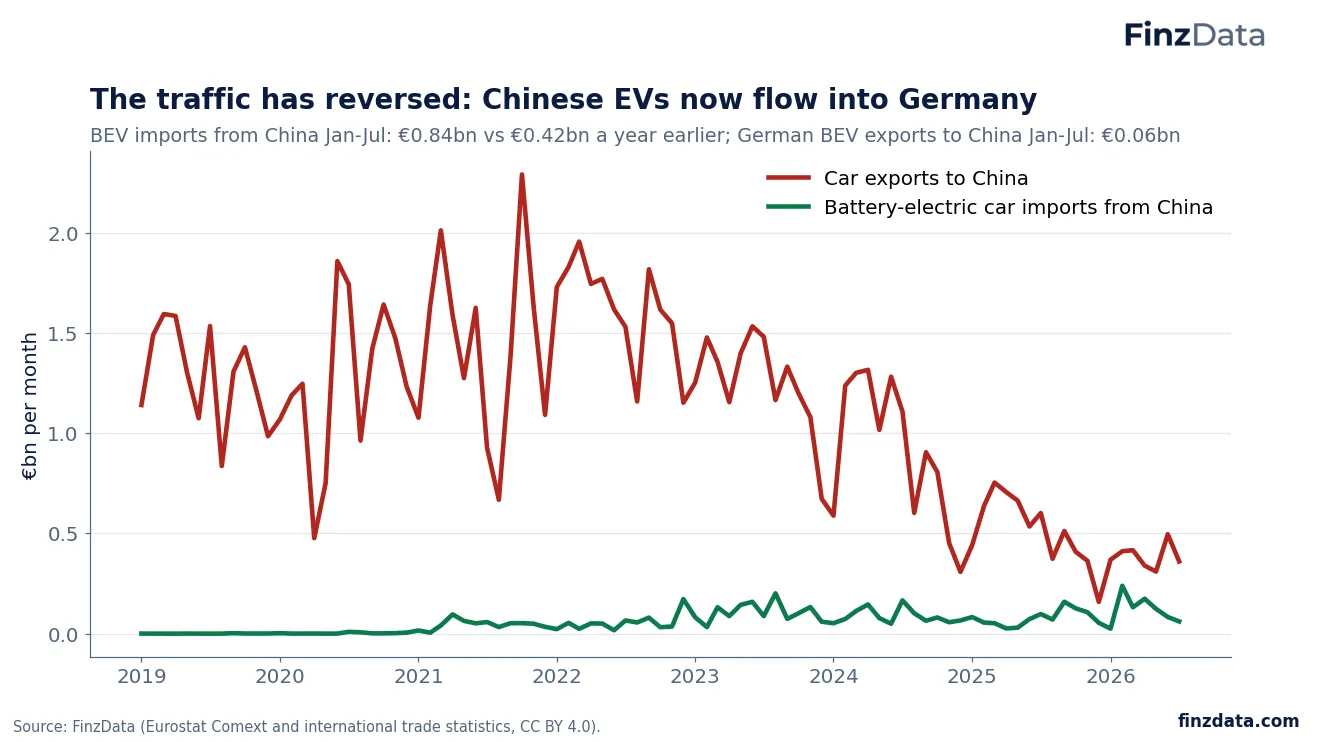
Monthly car exports to China and battery-electric car imports from China.
German car exports to China peaked in 2021-2022 and have fallen almost every year since, down -38% more in 2026. In the other direction, Germany imported €0.84 billion of battery-electric cars from China in January-July 2026, twice the €0.42 billion a year earlier, while it exported only €0.06 billion of them to China. In Q3 2026 Volkswagen's China deliveries fell 38.5%, Mercedes' 31% and BMW's 24.8%.
7. Tariffs took a third off US sales. The rebound has started
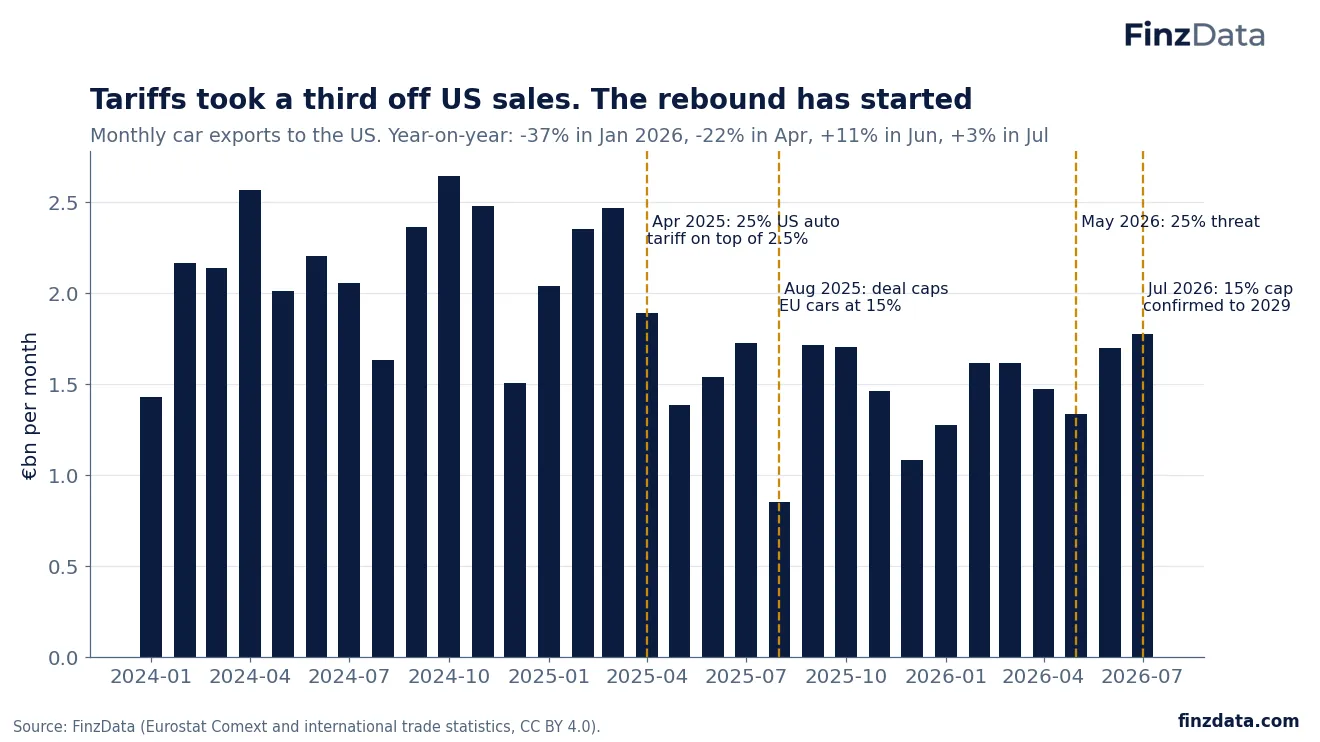
Monthly car exports to the US, with tariff dates.
The US added a 25% tariff on imported cars in April 2025 on top of the 2.5% duty. The EU-US deal capped EU cars at 15% from August 2025; in May 2026 President Trump threatened to raise it to 25%, and the EU then fast-tracked the deal's legislation, which took effect on July 1, 2026 with the 15% cap set to run to 2029. Exports to the US were -37% year on year in January 2026 and -22% in April, then turned positive in June (+11%) and July (+3%).
8. Winners and losers: the EU holds, China and the Gulf collapse
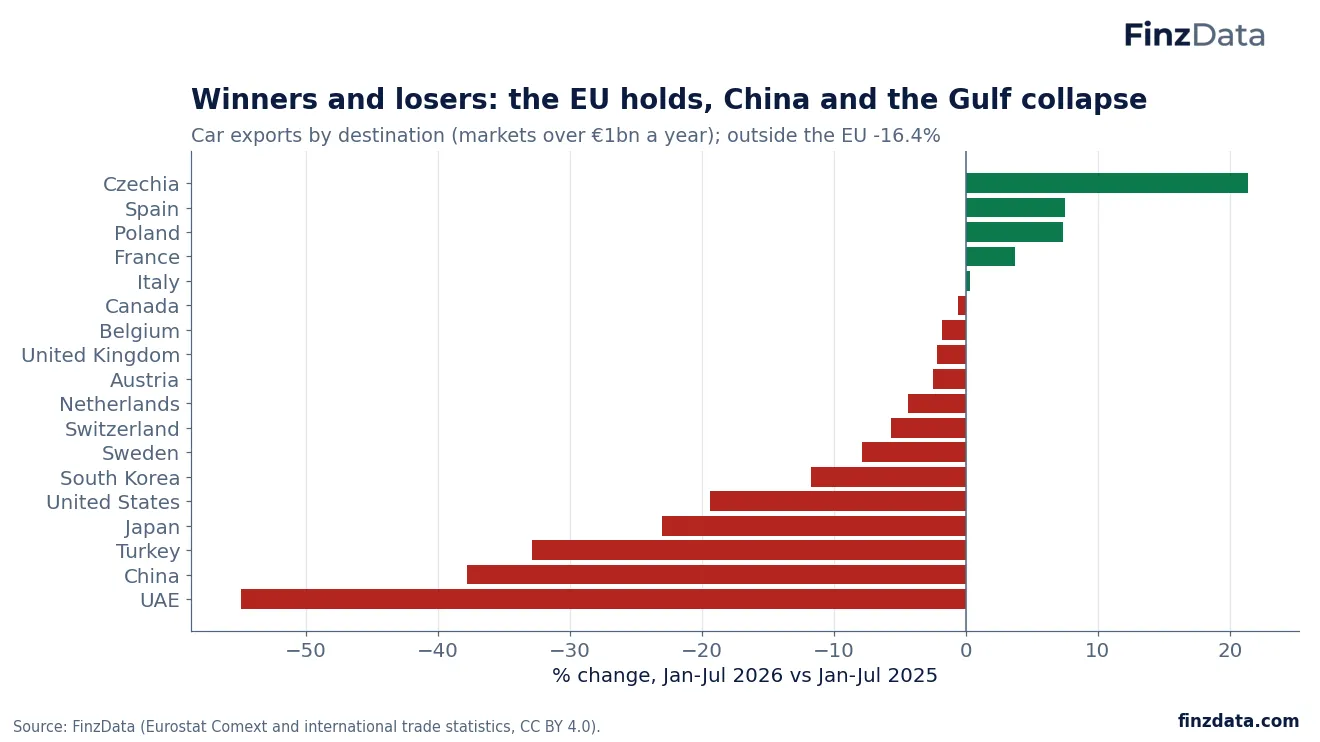
Change in car exports by destination, January-July 2026 vs 2025.
Exports to Czechia, Spain, Poland, France and Italy rose this year. The big falls were the UAE (-55%), China (-38%), Turkey (-33%), Japan (-23%) and the US (-19%). Exports outside the EU fell -16.4%.
9. The diesel era is over: plug-ins are 39% of car exports
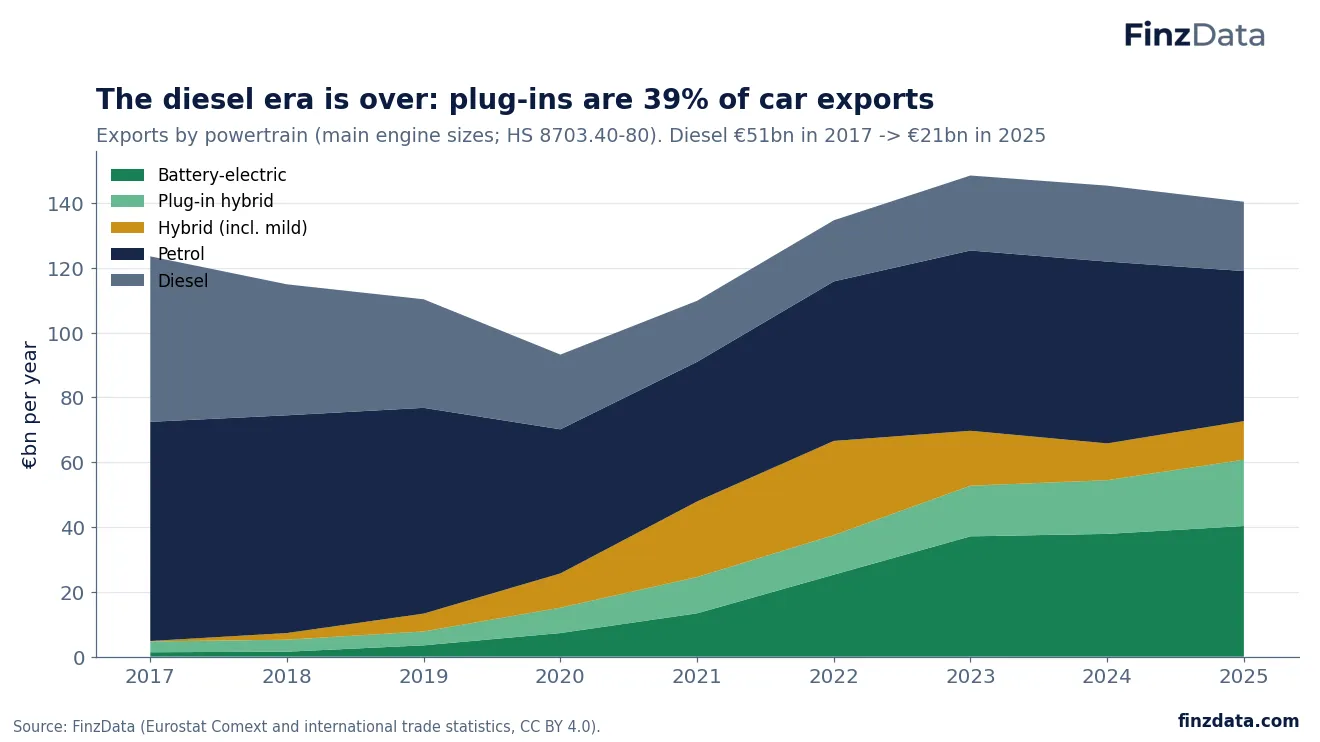
Exports by powertrain, 2017-2025.
Battery-electric and plug-in hybrid cars were about 39% of German car exports by value in 2025 (€40 billion BEV, €20 billion plug-in hybrid). Diesel exports fell from about €51 billion in 2017 to €21 billion in 2025. Hybrid figures include mild hybrids, whose customs classification changed around 2022.
10. Electric cars: exports slip, imports surge
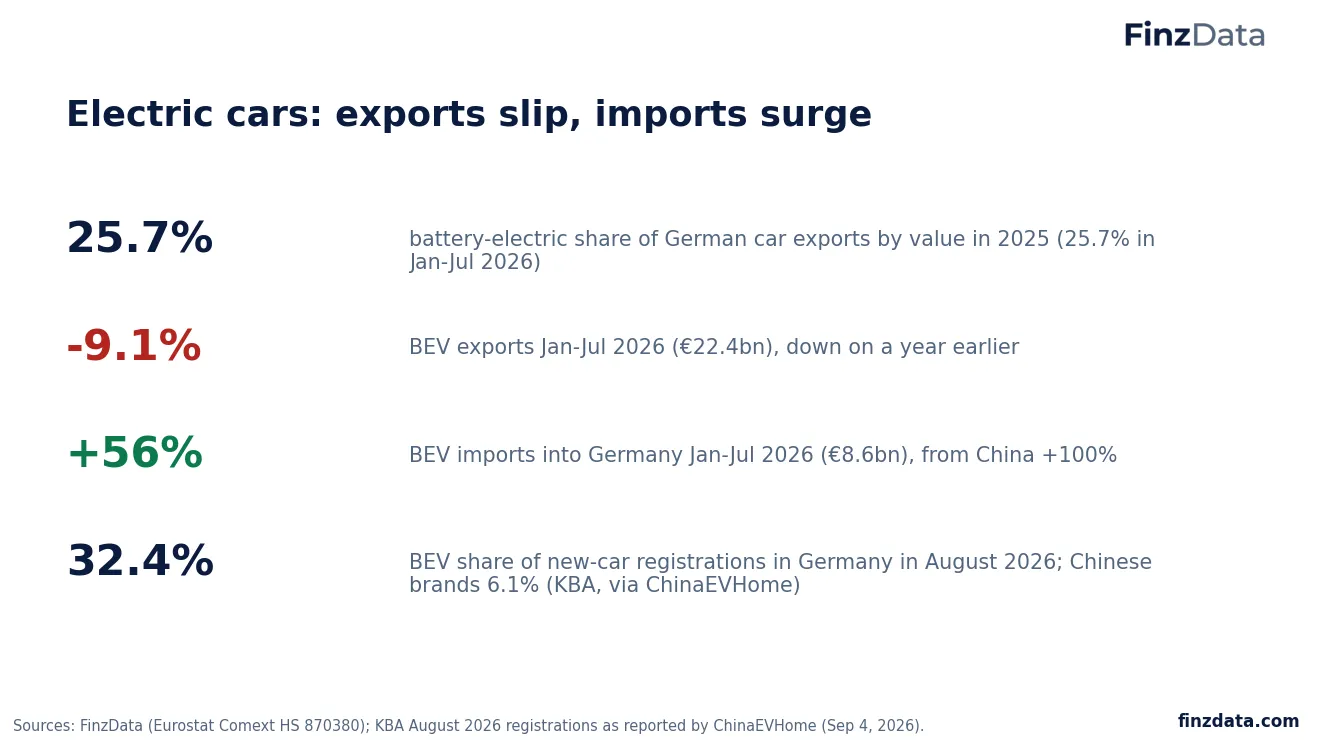
Battery-electric car exports and imports.
Battery-electric cars were 25.7% of German car exports by value in 2025 and 25.7% in January-July 2026, but BEV exports fell -9.1% this year. BEV imports into Germany rose 56% to €8.6 billion as the German market electrified: BEVs were 32.4% of new registrations in August 2026 and Chinese brands 6.1% (KBA, as reported by ChinaEVHome).
11. Q3 2026: China is where the volume went
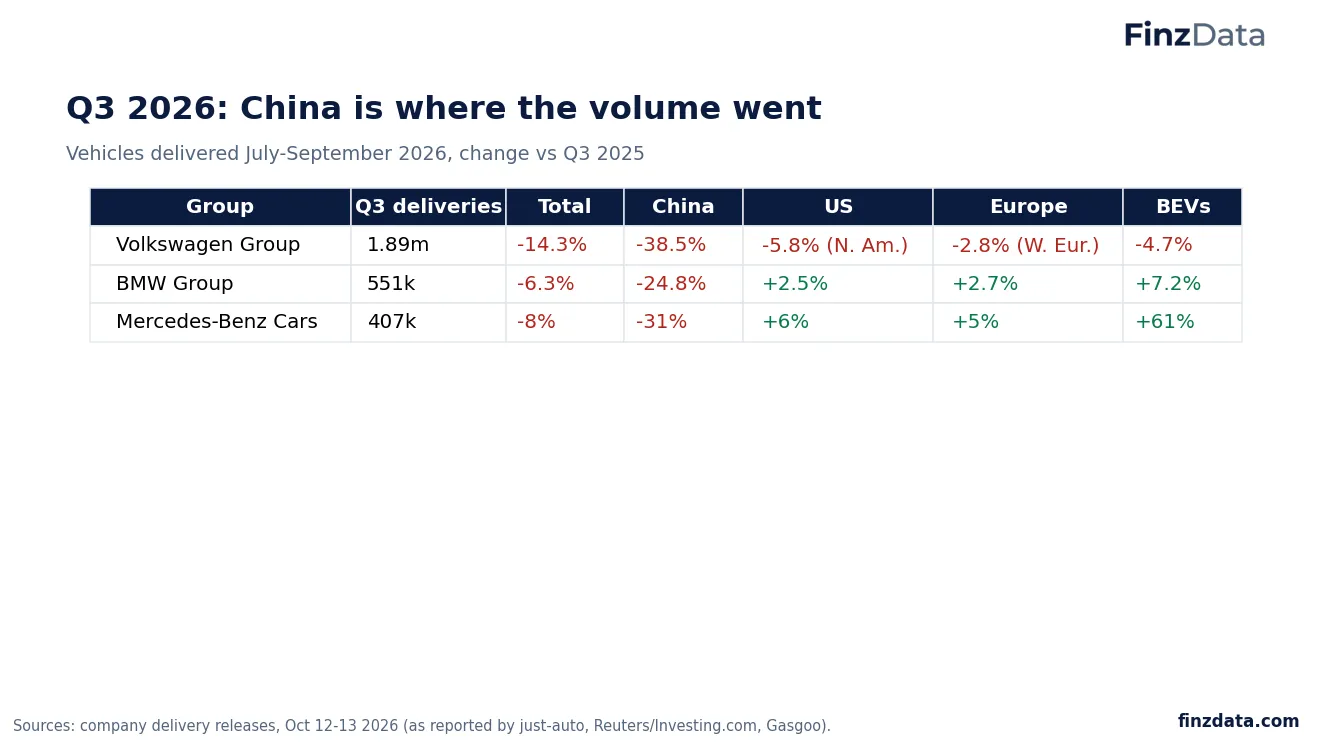
Q3 2026 deliveries by region, change vs Q3 2025.
Volkswagen Group delivered 1.89 million vehicles in Q3 2026 (-14.3%; China -38.5%, North America -5.8%, Western Europe -2.8%). BMW delivered 551,072 (-6.3%; China -24.8%, US +2.5%, Europe +2.7%). Mercedes-Benz Cars sold 407,200 (-8%; China -31%, US +6%, Europe +5%; BEVs +61% to a record 16.8% share).
12. Brand scorecard: only MINI is growing
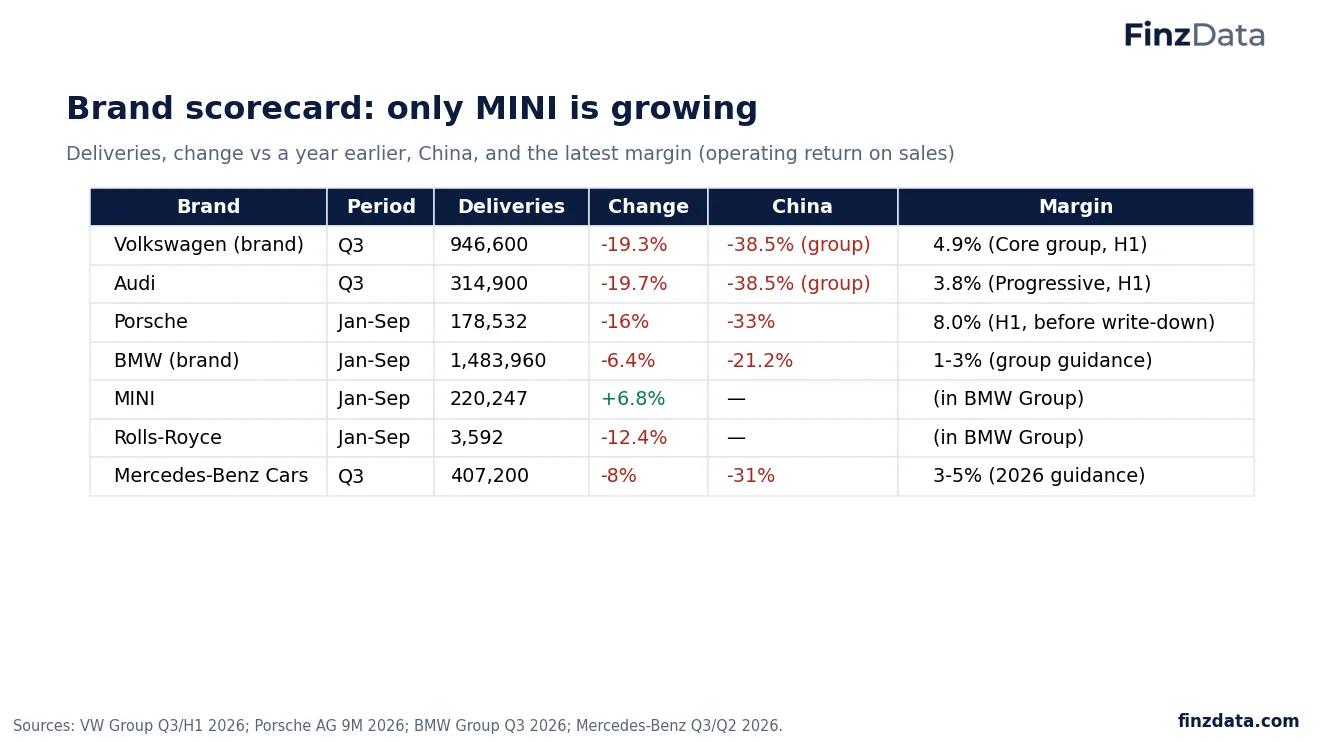
Deliveries, change, China and latest margin by brand.
Volkswagen Passenger Cars delivered 946,600 vehicles in Q3 2026 (-19.3%) and Audi 314,900 (-19.7%), with the group's China deliveries down 38.5%; their brand groups earned operating margins of 4.9% (Core) and 3.8% (Progressive) in the first half. Porsche delivered 178,532 cars in January-September (-16%; China -33%). The BMW brand delivered 1,483,960 (-6.4%; China -21.2%) and Rolls-Royce 3,592 (-12.4%), while MINI grew 6.8% to 220,247. Mercedes-Benz Cars sold 407,200 in Q3 (-8%; China -31%) and guides a 3-5% return on sales for 2026.
13. Porsche: the 911 is the last growth engine
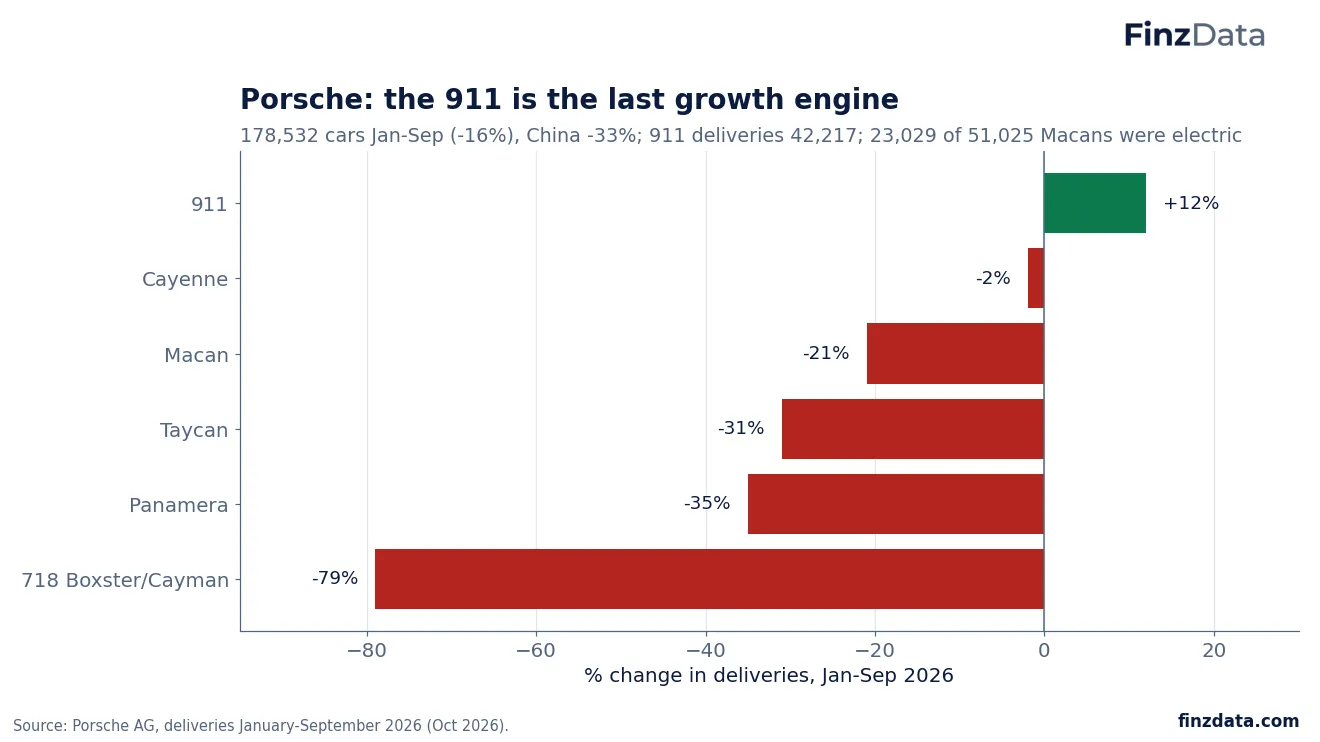
Porsche deliveries by model, January-September 2026.
Porsche's 911 grew 12% to 42,217 cars in the first nine months of 2026; every other line fell: Cayenne -2%, Macan -21% (23,029 of its 51,025 Macans were electric), Taycan -31%, Panamera -35% and the outgoing 718 -79%. China fell 33% to 21,493 cars and North America 13%. Volkswagen wrote down about €6 billion of Porsche goodwill in September after Porsche cut its long-term plan.
14. BMW: a China problem, an electric answer
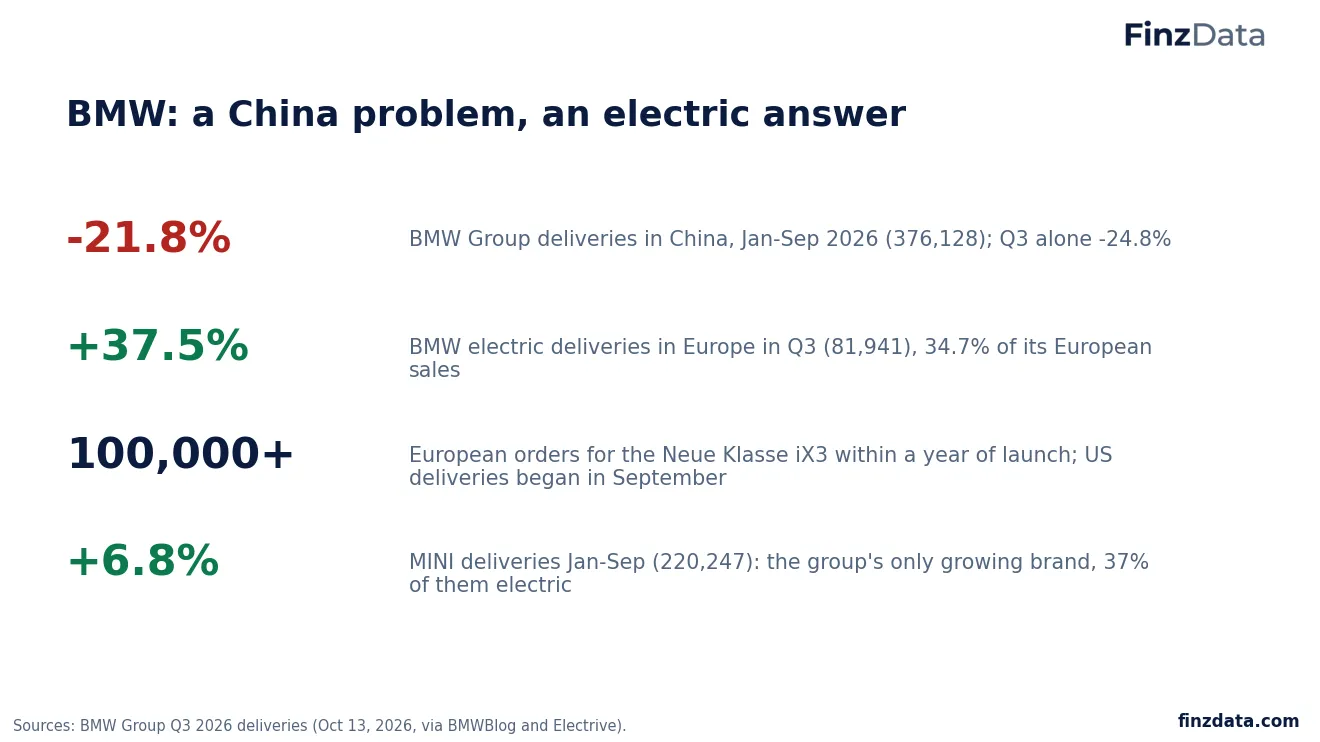
BMW Group, Q3 and January-September 2026.
BMW Group deliveries in China fell 21.8% in January-September to 376,128 (Q3 alone -24.8%), while the US (+3.4%) and Europe (+4.5%) grew. In Europe BMW's electric deliveries rose 37.5% in Q3 to 81,941, 34.7% of its European sales, and the Neue Klasse iX3 passed 100,000 European orders within a year; US deliveries started in September. MINI, 37% electric, is the group's only growing brand.
15. Mercedes-Benz: electric sales boom, China does not
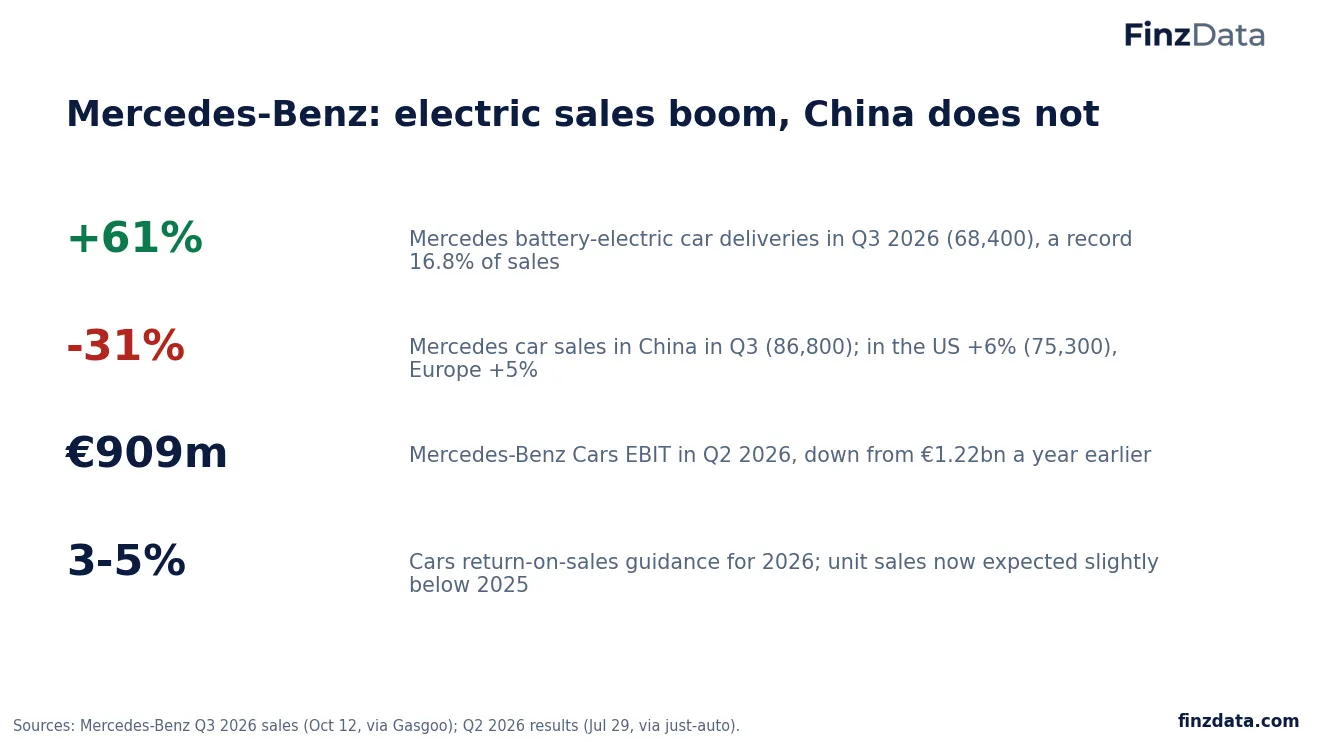
Mercedes-Benz Cars, Q2 and Q3 2026.
Mercedes delivered 68,400 battery-electric cars in Q3 2026 (+61%), a record 16.8% of its sales. China fell 31% to 86,800, while the US rose 6% and Europe 5%. Mercedes-Benz Cars' Q2 EBIT fell to €909 million from €1.22 billion; the company kept its 3-5% Cars return-on-sales guidance but now expects unit sales slightly below 2025.
16. At home, Tesla and the Chinese brands are taking share
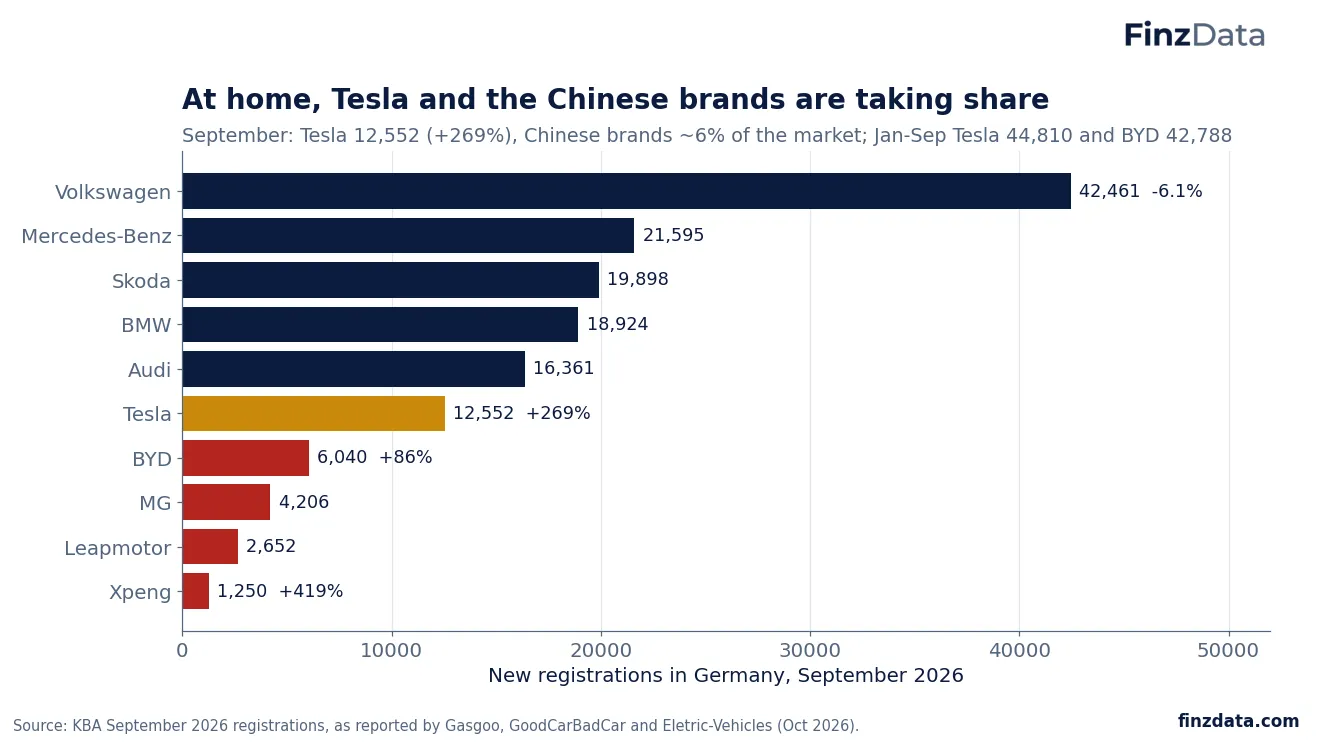
German new-car registrations by brand, September 2026.
Volkswagen is still Germany's biggest brand (42,461 registrations in September, -6.1%, 16.5% of the market), ahead of Mercedes-Benz, Skoda, BMW and Audi. But Tesla registered 12,552 (+269%) and Chinese brands about 6% of the market: BYD 6,040 (+86%), MG 4,206, Leapmotor 2,652 and Xpeng 1,250 (+419%). In January-September Tesla registered 44,810 cars in Germany and BYD 42,788. Figures are KBA data as reported by Gasgoo, GoodCarBadCar and Eletric-Vehicles.
17. VW's China profit engine has nearly stalled
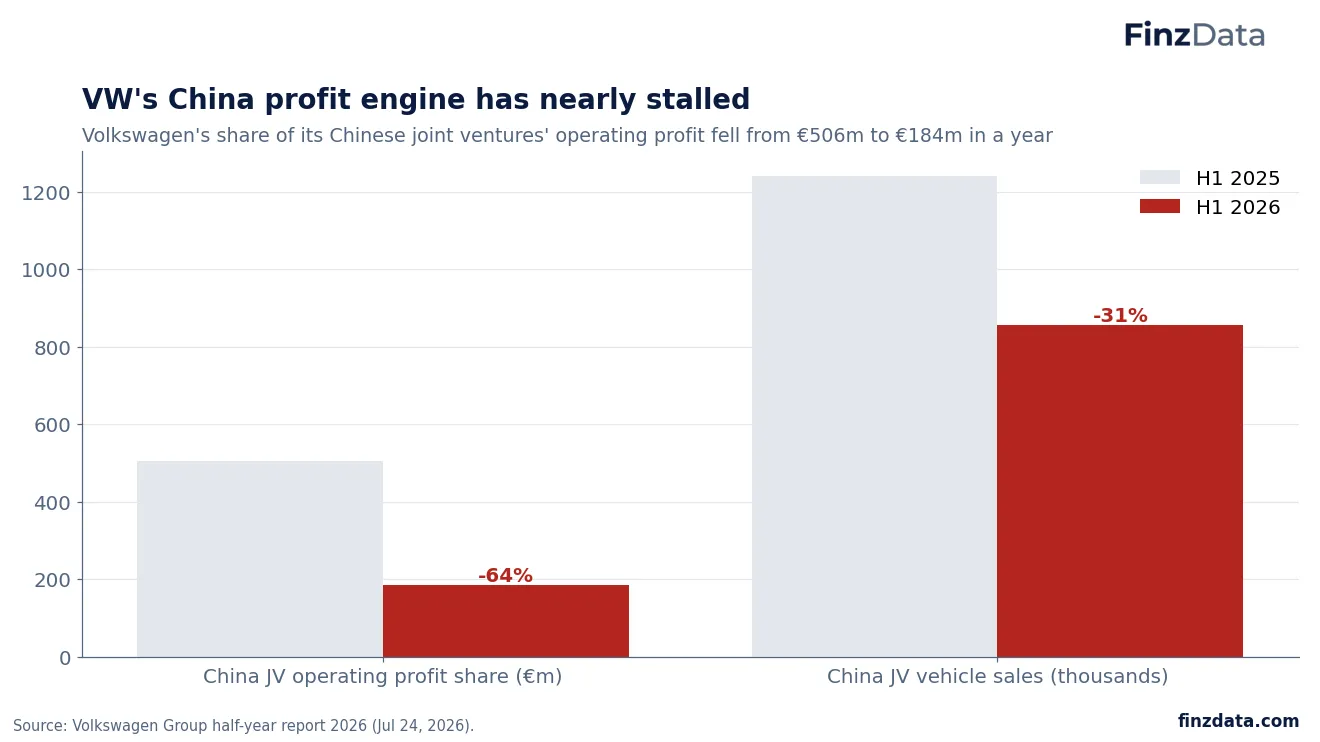
Volkswagen's Chinese joint ventures, H1 2026 vs H1 2025.
Volkswagen's share of the operating profit of its Chinese joint ventures fell from €506 million in the first half of 2025 to €184 million in the first half of 2026 (-64%), as their vehicle sales dropped from 1.24 million to 856,000 (-31%). For two decades those joint ventures were among the most profitable parts of the group.
18. Profits and jobs are following volumes down
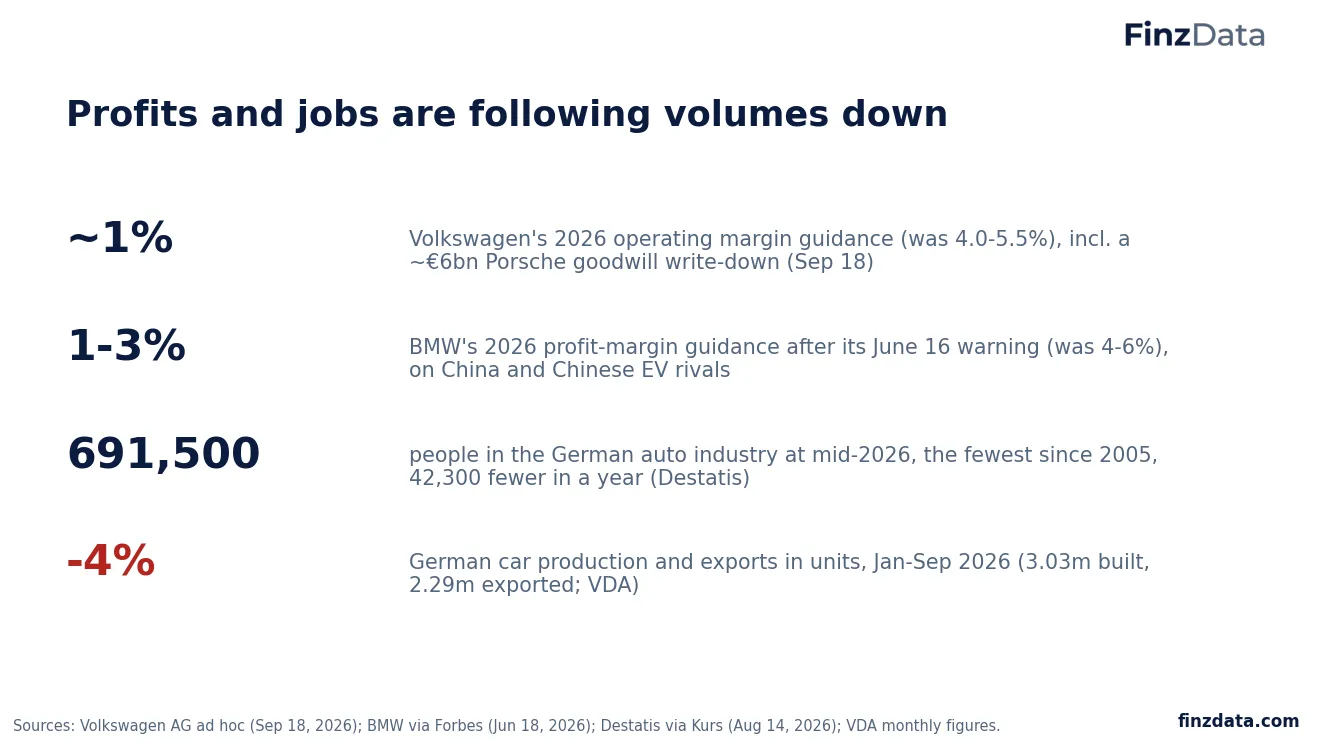
Guidance cuts, employment and units.
On September 18, 2026 Volkswagen cut its 2026 operating margin guidance to up to about 1% from 4.0-5.5%, including a roughly €6 billion write-down of Porsche goodwill and China charges. BMW cut its 2026 profit-margin guidance to 1-3% from 4-6% on June 16. Employment in the German auto industry fell to about 691,500 at mid-2026, the lowest since 2005 and 42,300 fewer than a year earlier (Destatis).
19. The market's verdict: carmakers down a third, trucks up
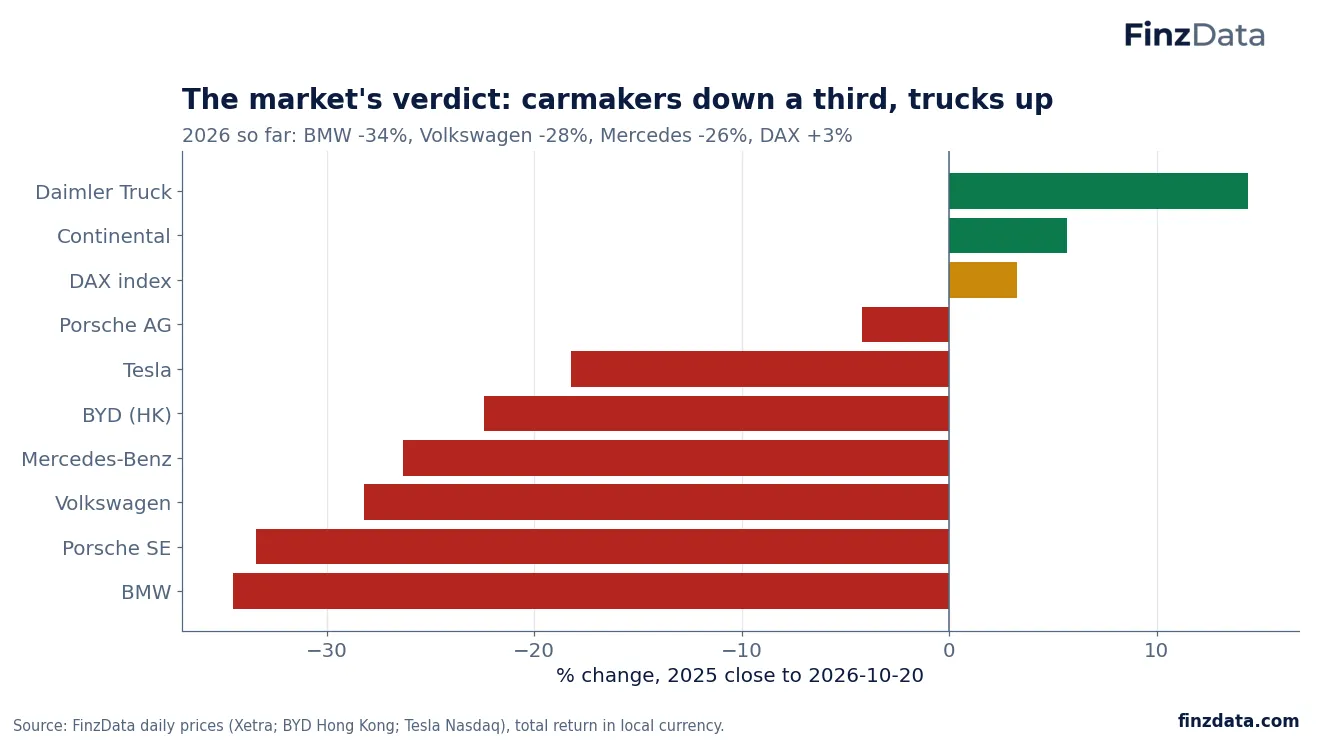
Share prices in 2026 so far, local currency.
From the 2025 close to October 20, 2026: BMW -34%, Porsche SE -33%, Volkswagen -28%, Mercedes-Benz -26% and Porsche AG -4%, against the DAX +3%. Daimler Truck (+14%) and Continental (+6%) rose. BYD (-22%) and Tesla (-18%) also fell, so this is not simply a shift of value to EV makers.
20. Trade data tells you what happened, not what is next
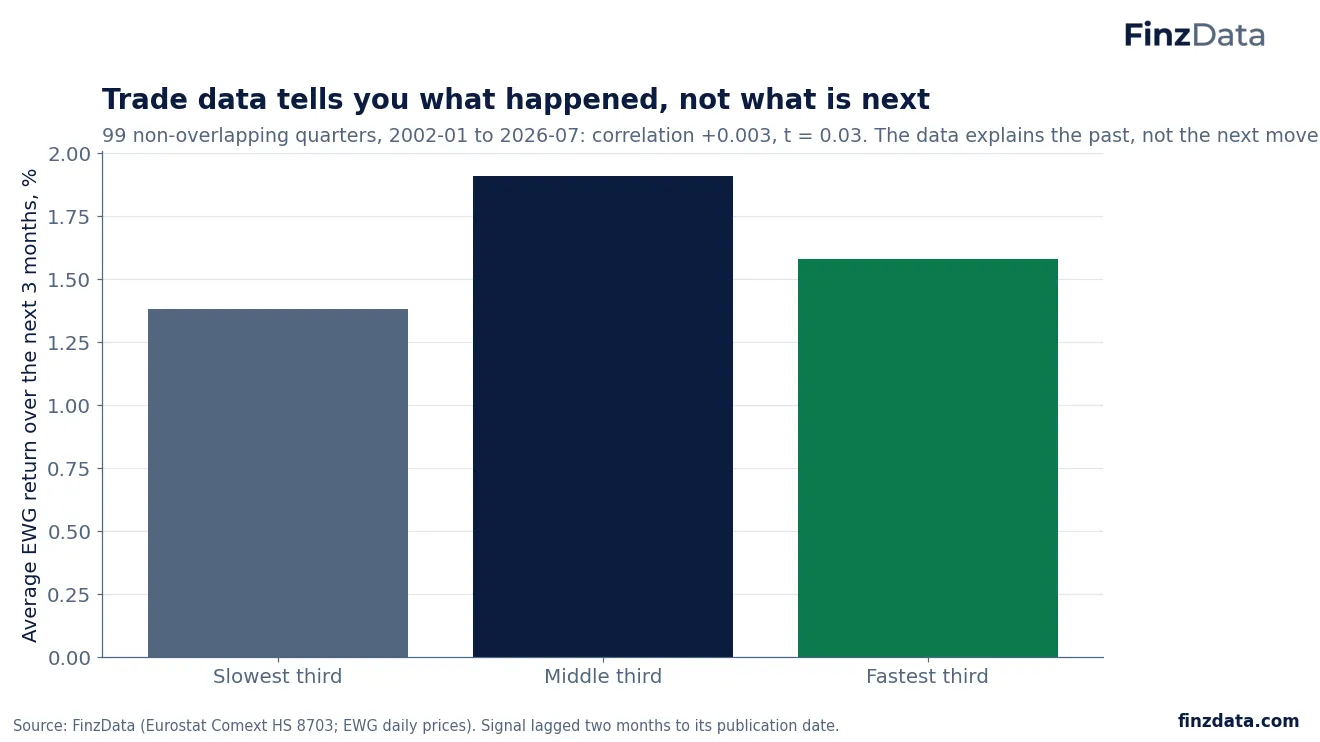
EWG returns over the next three months, by car-export growth tercile.
We tested whether faster growth in German car exports (three-month total vs a year earlier, lagged two months to when Eurostat publishes it) predicts the next three months of EWG, the MSCI Germany ETF. Over 99 non-overlapping quarters from 2002-01 to 2026-07 the correlation was +0.003 (t = 0.03); next-quarter returns were 1.4%, 1.9% and 1.6% for slow, middle and fast growth. The export data explains what happened; it gives no edge on the next move.
21. Our read: a structural squeeze, not a bad year
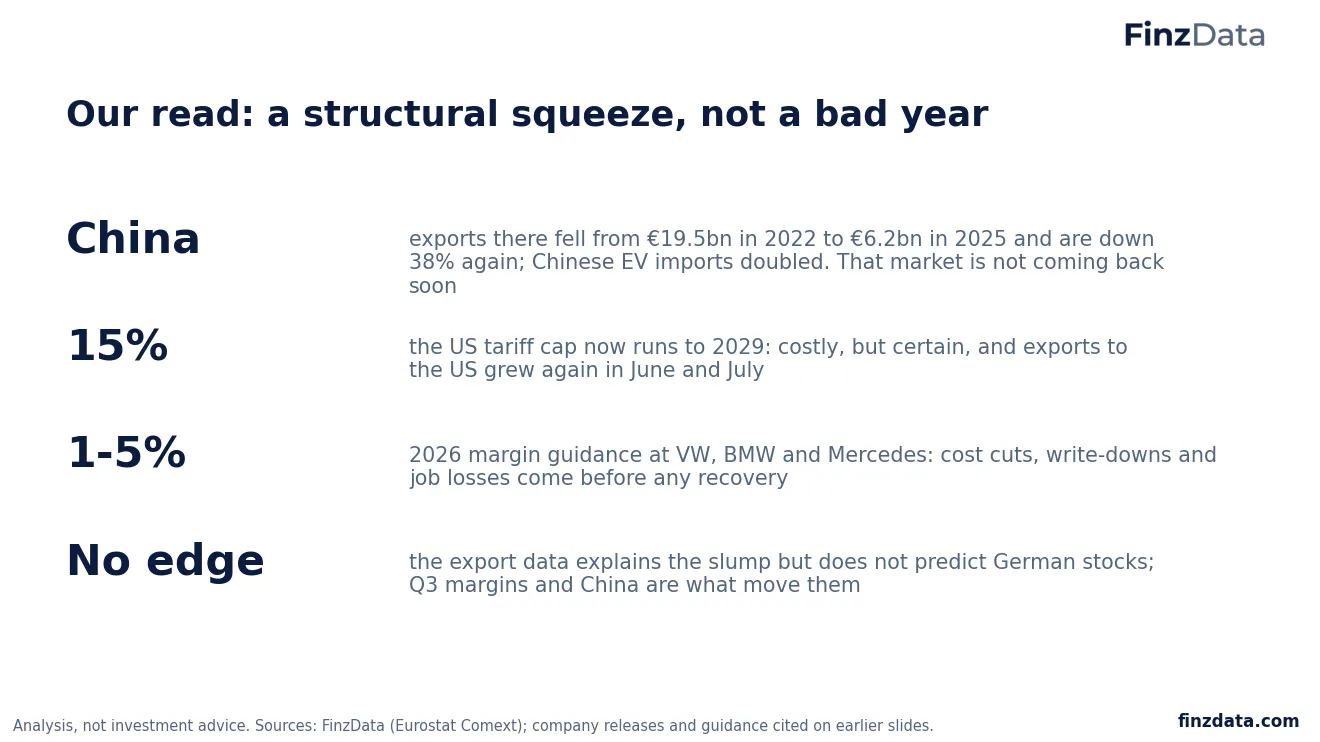
Implications.
This looks structural rather than cyclical. German car exports to China fell from €19.5 billion in 2022 to €6.2 billion in 2025 and are down another 38% this year, while battery-electric imports from China doubled: that market is not coming back soon. The 15% US tariff cap now runs to 2029, which is costly but at least certain, and exports to the US grew again year on year in June and July. With 2026 margin guidance of roughly 1-5% at Volkswagen, BMW and Mercedes-Benz, cost cuts, write-downs and job losses come before any recovery. The export data explains the slump but does not predict German stocks; third-quarter margins and China are what will move them. This is analysis, not investment advice.
22. What to watch
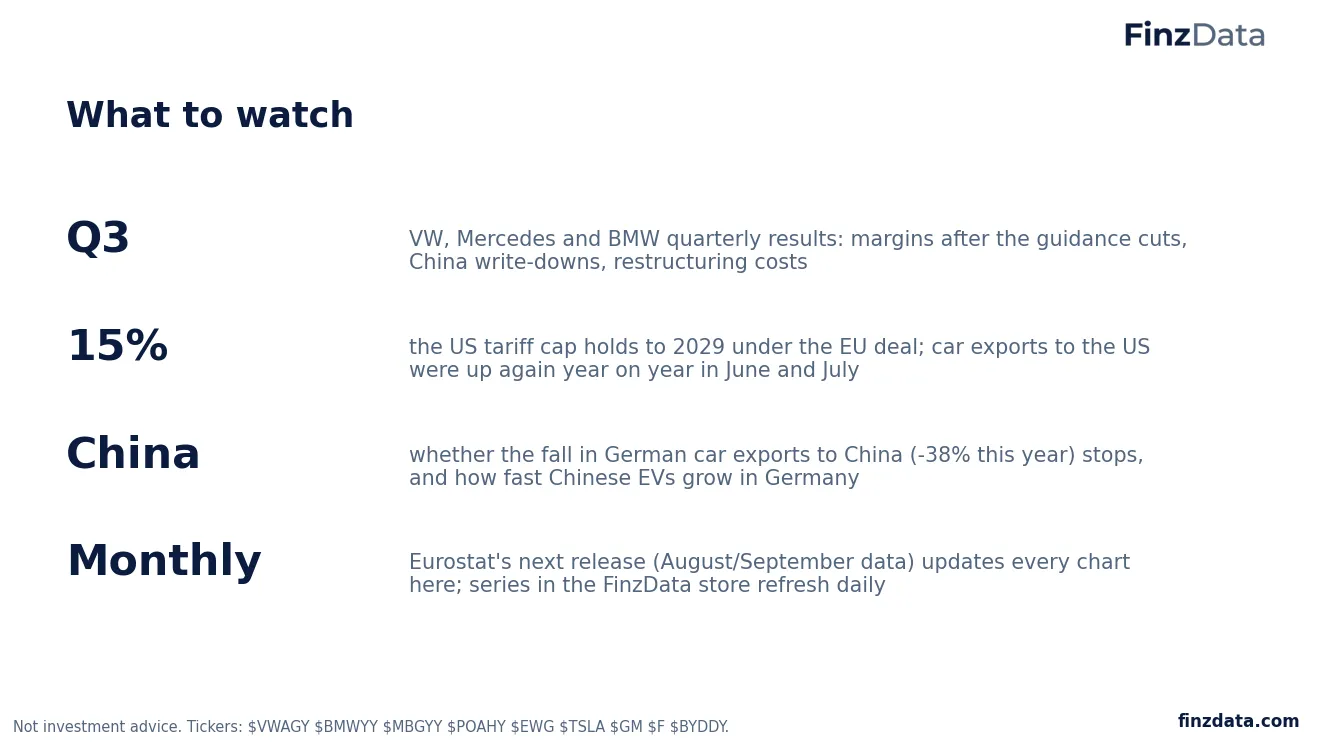
Third-quarter results from Volkswagen, Mercedes-Benz and BMW, for margins after the guidance cuts; whether the 15% US tariff cap holds and the June-July recovery in US exports continues; whether exports to China stop falling; and the speed of Chinese EV growth in Germany. Eurostat's next monthly release updates every chart in this deck; the series refresh daily in FinzData.
23. The data behind this deck
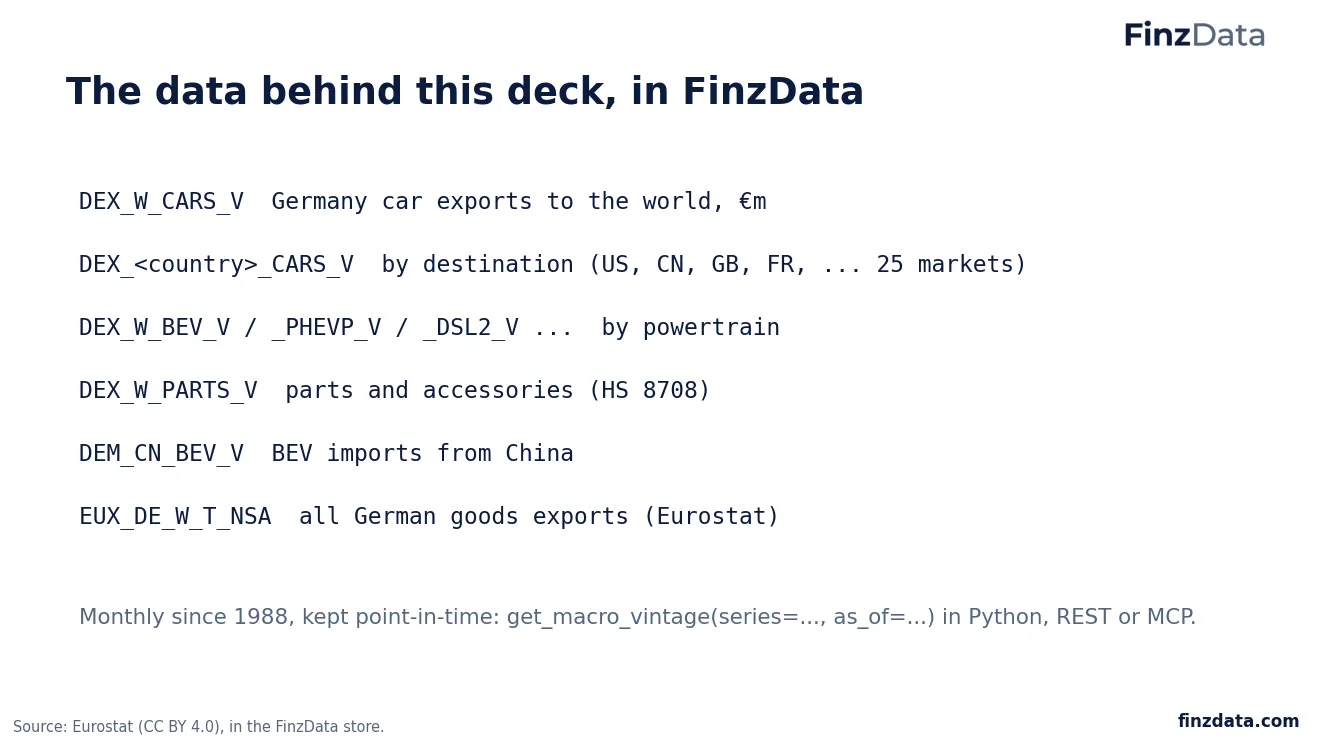
Every chart is built from series anyone can pull from FinzData: DEX_W_CARS_V (car exports to the world), DEX_<country>_CARS_V for 25 destinations, powertrain series such as DEX_W_BEV_V, DEX_W_PARTS_V for parts, DEM_CN_BEV_V for BEV imports from China and EUX_DE_W_T_NSA for all German goods exports, monthly since 1988 and kept point-in-time. Fetch them with get_macro_vintage in Python, REST or MCP.
Frequently asked questions
How important are cars to German exports?
Passenger cars and parts were 13.6% of Germany's goods exports in 2025 (€157 billion of cars plus €56 billion of parts).
Who buys the most German cars?
The United States (€20.2 billion in 2025), then the United Kingdom (€15.9 billion) and Italy. China was ninth at €6.2 billion, down from €15.5 billion in 2019.
What tariff do German cars pay in the US?
15% under the EU-US deal, in force since July 1, 2026 and capped through 2029, after a 27.5% rate (25% plus 2.5%) from April to July 2025.
Does car-export data predict German stocks?
Not in our test: over 99 quarters since 2002 the correlation with EWG's next-quarter return was +0.003.
Which German car brand is doing best?
MINI is the only one growing (+6.8% in January-September 2026). Among the rest, the Porsche 911 (+12%) and Mercedes' electric cars (+61% in Q3) are the bright spots; Volkswagen and Audi deliveries fell about 19% in Q3.
Download the deck (PDF, 23 slides) More research
Built for AI, quants, data scientists and financial analysts who backtest. Clean data. Real insights. Real alpha. finzdata.com. This material is for information only and is not investment advice. Data sources: FinzData store: Eurostat Comext DS-045409 (Germany exports and imports by HS product and partner, 1988-2026) and Eurostat international trade in goods (CC BY 4.0); daily prices for VOW3, BMW, MBG, P911, PAH3, CON, DTG, DAX, BYD, TSLA and EWG. VDA monthly figures (September 2026); Destatis auto employment (August 2026); Volkswagen, BMW and Mercedes-Benz Q3 2026 delivery releases (October 12-13, 2026); Volkswagen AG ad hoc release (September 18, 2026); BMW guidance (June 16, 2026); EU-US trade deal implementation (July 1, 2026); KBA registrations via ChinaEVHome (September 4, 2026). Porsche AG deliveries 9M 2026; Volkswagen Group half-year report 2026; BMW Group Q3 2026 (BMWBlog, Electrive); Mercedes-Benz Q2 2026 (just-auto); KBA September 2026 registrations via Gasgoo, GoodCarBadCar and Eletric-Vehicles.
Get FinzData research free, every morning
The daily brief: what moved, the macro releases that matter, positioning and liquidity, with charts. One email a day, free, unsubscribe anytime.
Topics and related searches
Autos and EVs European economies and markets Exports and global trade
People also search
- will german car exports recover in 2027
- why are german car exports falling
- how much did german car exports fall in 2026
- how important are cars to german exports
- who buys the most german cars in 2025
- when did german car exports peak
- are german car exports to china recovering
- does us tariff cap help german auto exports
- can german automakers compete with chinese evs
- what is the share of plug in cars in german exports
- german car exports january july 2026 data
- german auto exports by destination 2025