
FinzData Research · Published 15 November 2026
The Last Great AI Trade? Anthropic's IPO (ANT), by the Numbers (Institutional Deck)
Anthropic prices the second-largest IPO on record on 18 November 2026 and lists on Nasdaq as ANT the next day. We read the S-1 and its amendment in full: revenue, customers, margins, cash flow, the $900.9 billion compute map, the lock-up calendar and valuation against SpaceX, Facebook, Alibaba and Aramco, then measure what it means for semiconductors (SMH), neoclouds, power and Bitcoin ETF flows.
Get FinzData research free, every morning
The daily brief: what moved, the macro releases that matter, positioning and liquidity, with charts. One email a day, free, unsubscribe anytime.
Contents
- Likely the top of the easy hardware trade. Not yet evidence of a top in AI demand.
- ANT: the second-largest IPO on record, priced into a falling tape
- Revenue went from $0.2B to $17B a quarter in seven quarters
- Four-fifths of revenue is metered usage, and half arrives through the cloud marketplaces
- Large customers grew from about 200 to 11,900 in 21 months; no active-user count is given
- Compute fell from 251% of revenue to 48%, then rose to 58% in Q3 as spending stepped up
- Operations turned cash-positive in 2026; the $132B on the balance sheet came from investors
- The burn is contractual and still ahead: $70.7B falls due in the next twelve months
- The IPO range sits 19% to 32% above a private round done six months ago
- On trailing sales Anthropic prices like Facebook in 2012, at a third of SpaceX's multiple
- Open models: named in one paragraph, answered with the frontier
- Open models are winning tokens, not dollars, and the pressure is at the low end
- Anthropic owes more for Google-designed chips than for everything built on Nvidia
- The last record IPO marked the high in semis within six sessions
- Semis ran 55% into SpaceX's listing and fell 17% after; Anthropic arrives with them already down 14%
- Index rules put a passive bid under ANT in December, funded by selling everything else
- Only 6% floats on day one; the first insider release lands days before likely index entry
- The November crash was a deleveraging event; much of the forced selling is done
- Semis peaked ten days after the last record IPO; Nvidia made one more high; Bitcoin rolled over last
- Neoclouds halved, memory fell hardest, and Nvidia is negative on the year
- Dealers are short gamma in SMH and Nvidia into the event week, which amplifies moves both ways
- SMH is 27% off its high and still up 35% on the year
- Buyers are still showing up; they are choosing different names
- Inside SMH, leadership left Nvidia months ago and moved to the bottleneck
- Neoclouds: the demand is contracted; the open question is who can finance delivery
- Hyperscalers are Anthropic's landlords, and three of four now spend more than they earn in cash
- Power: politics repriced the trade in a day; the order books have not slowed
- The bottleneck is where the margin goes, and it has moved down the stack
- Seven straight outflow days: $1.91B, most of it from one fund
- The funding-drain story is tidy, but the sizes point at rates, not the IPO
- Three paths for the 90 days after listing, and what each means by sector
- Both cases, on the evidence
- The calendar that settles most of this
- Built on FinzData, with the filing as the primary source
- Where the numbers come from
- Frequently asked questions
1. The Last Great AI Trade?
Revenue, customers, margins and cash flow from the filing; the $900B compute map; flows and positioning; sector read-through; scenarios and the calendar.
Analysis, not investment advice. Filing data from Anthropic's Form S-1 and amendments; market data from FinzData.
2. Likely the top of the easy hardware trade. Not yet evidence of a top in AI demand.
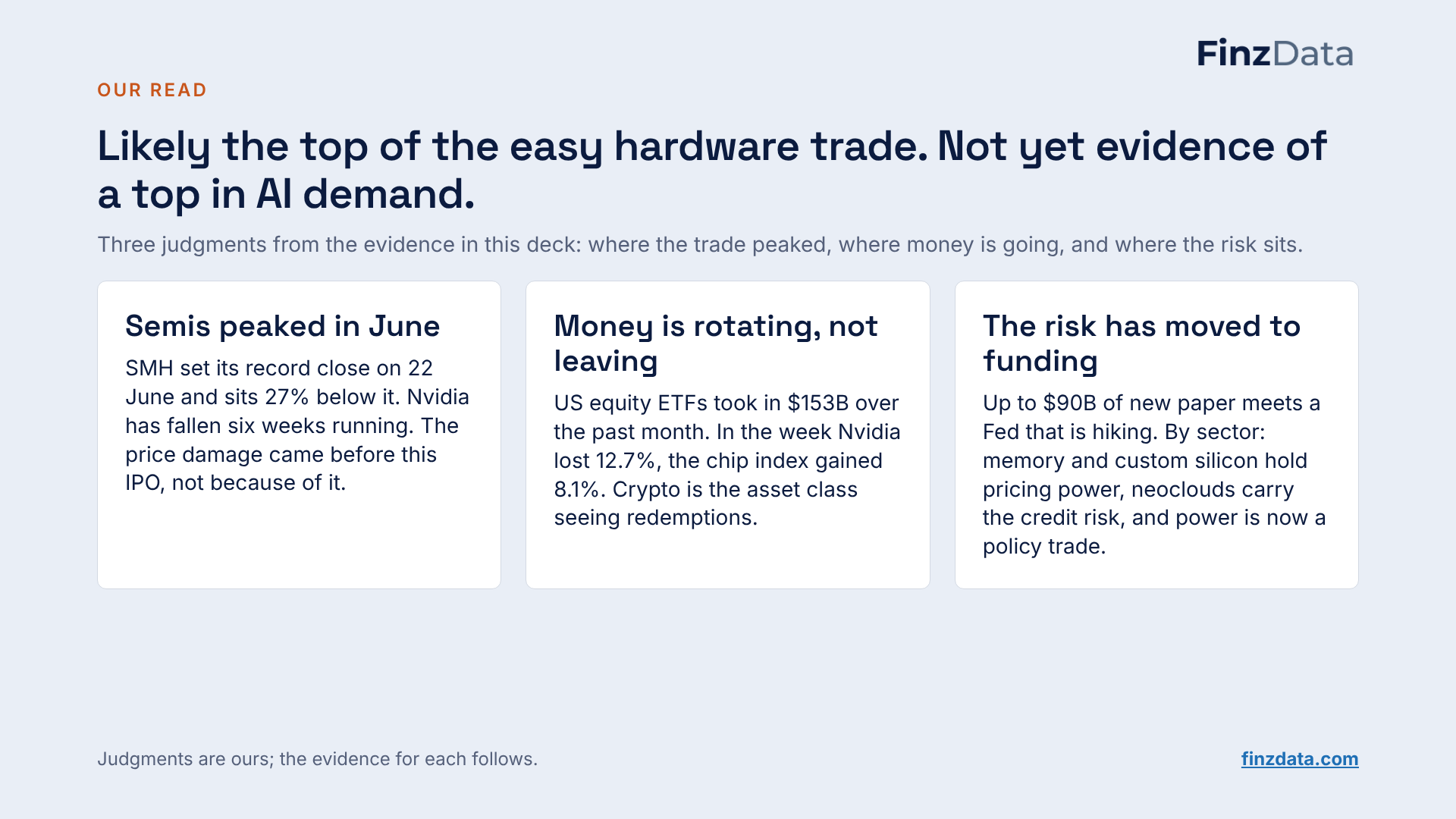
Three judgments from the evidence in this deck: where the trade peaked, where money is going, and where the risk sits.
SMH set its record close on 22 June and sits 27% below it. Nvidia has fallen six weeks running. The price damage came before this IPO, not because of it.
US equity ETFs took in $153B over the past month. In the week Nvidia lost 12.7%, the chip index gained 8.1%. Crypto is the asset class seeing redemptions.
Up to $90B of new paper meets a Fed that is hiking. By sector: memory and custom silicon hold pricing power, neoclouds carry the credit risk, and power is now a policy trade.
Judgments are ours; the evidence for each follows.
3. ANT: the second-largest IPO on record, priced into a falling tape
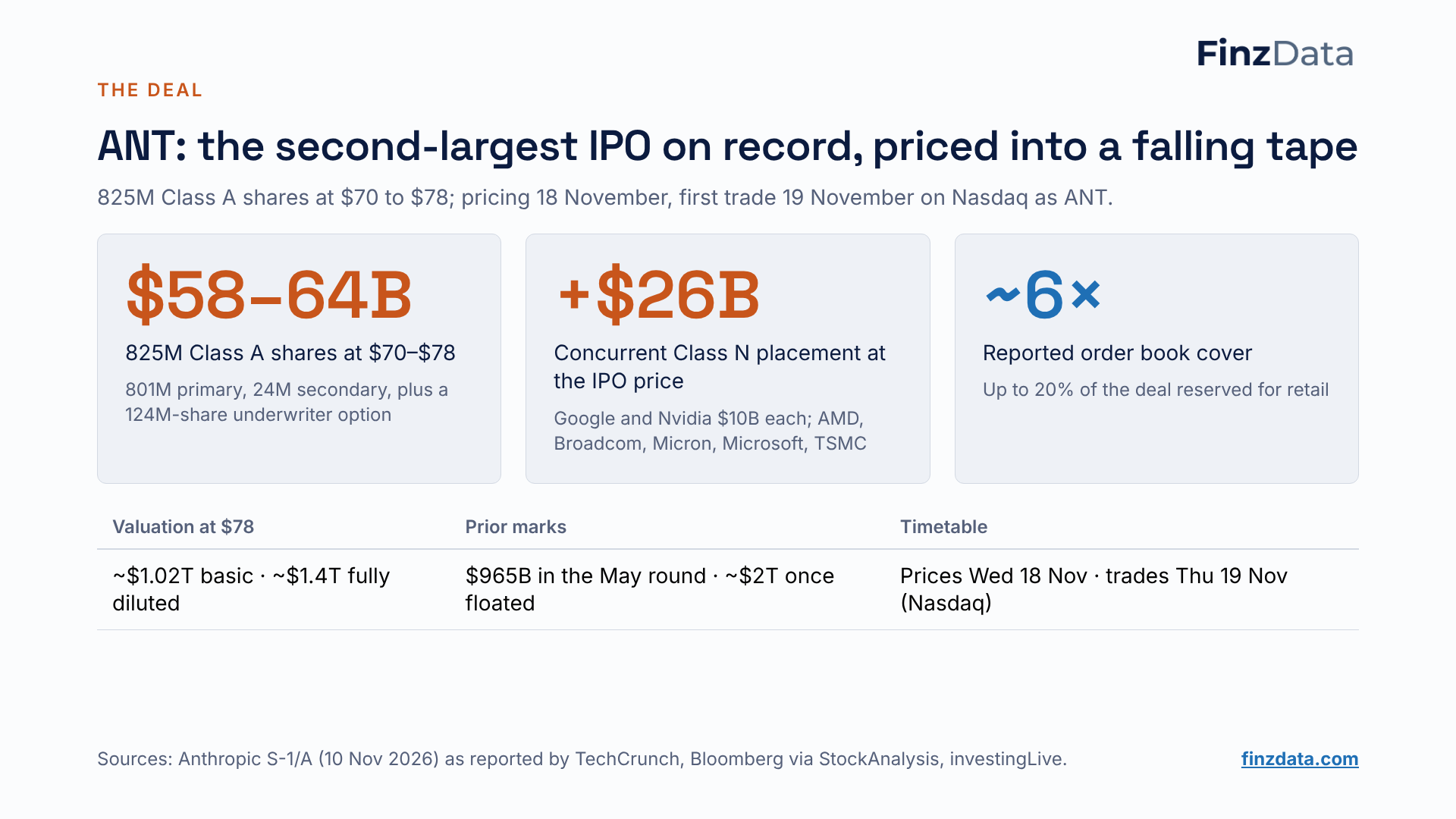
825M Class A shares at $70 to $78; pricing 18 November, first trade 19 November on Nasdaq as ANT.
825M Class A shares at $70–$78
Concurrent Class N placement at the IPO price
Reported order book cover
| Valuation at $78 | Prior marks | Timetable |
|---|---|---|
| ~$1.02T basic · ~$1.4T fully diluted | $965B in the May round · ~$2T once floated | Prices Wed 18 Nov · trades Thu 19 Nov (Nasdaq) |
Sources: Anthropic S-1/A (10 Nov 2026) as reported by TechCrunch, Bloomberg via StockAnalysis, investingLive.
4. Revenue went from $0.2B to $17B a quarter in seven quarters
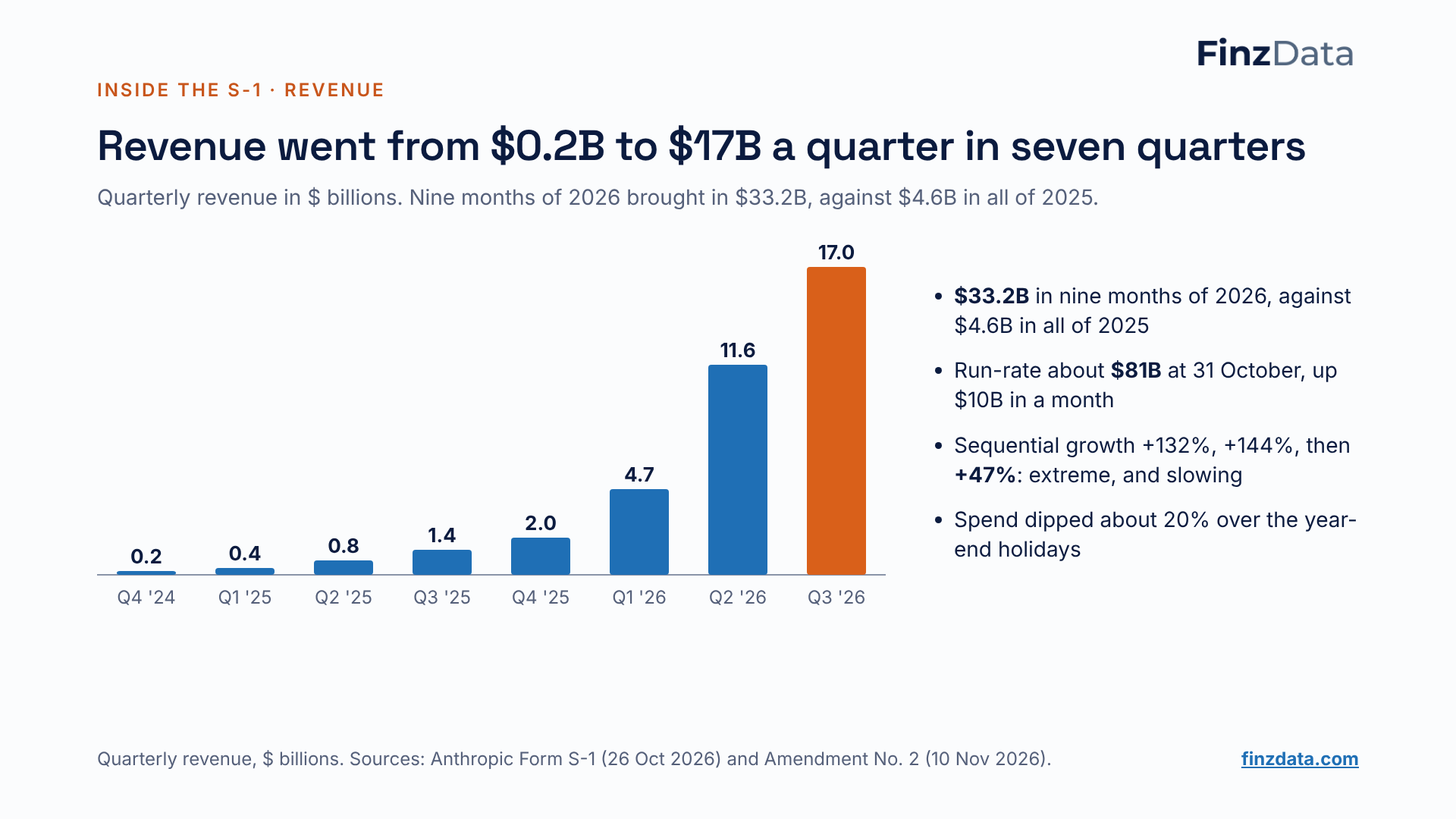
Quarterly revenue in $ billions. Nine months of 2026 brought in $33.2B, against $4.6B in all of 2025.
$33.2B in nine months of 2026, against $4.6B in all of 2025
Run-rate about $81B at 31 October, up $10B in a month
Sequential growth +132%, +144%, then +47%: extreme, and slowing
Spend dipped about 20% over the year-end holidays
Quarterly revenue, $ billions. Sources: Anthropic Form S-1 (26 Oct 2026) and Amendment No. 2 (10 Nov 2026).
5. Four-fifths of revenue is metered usage, and half arrives through the cloud marketplaces
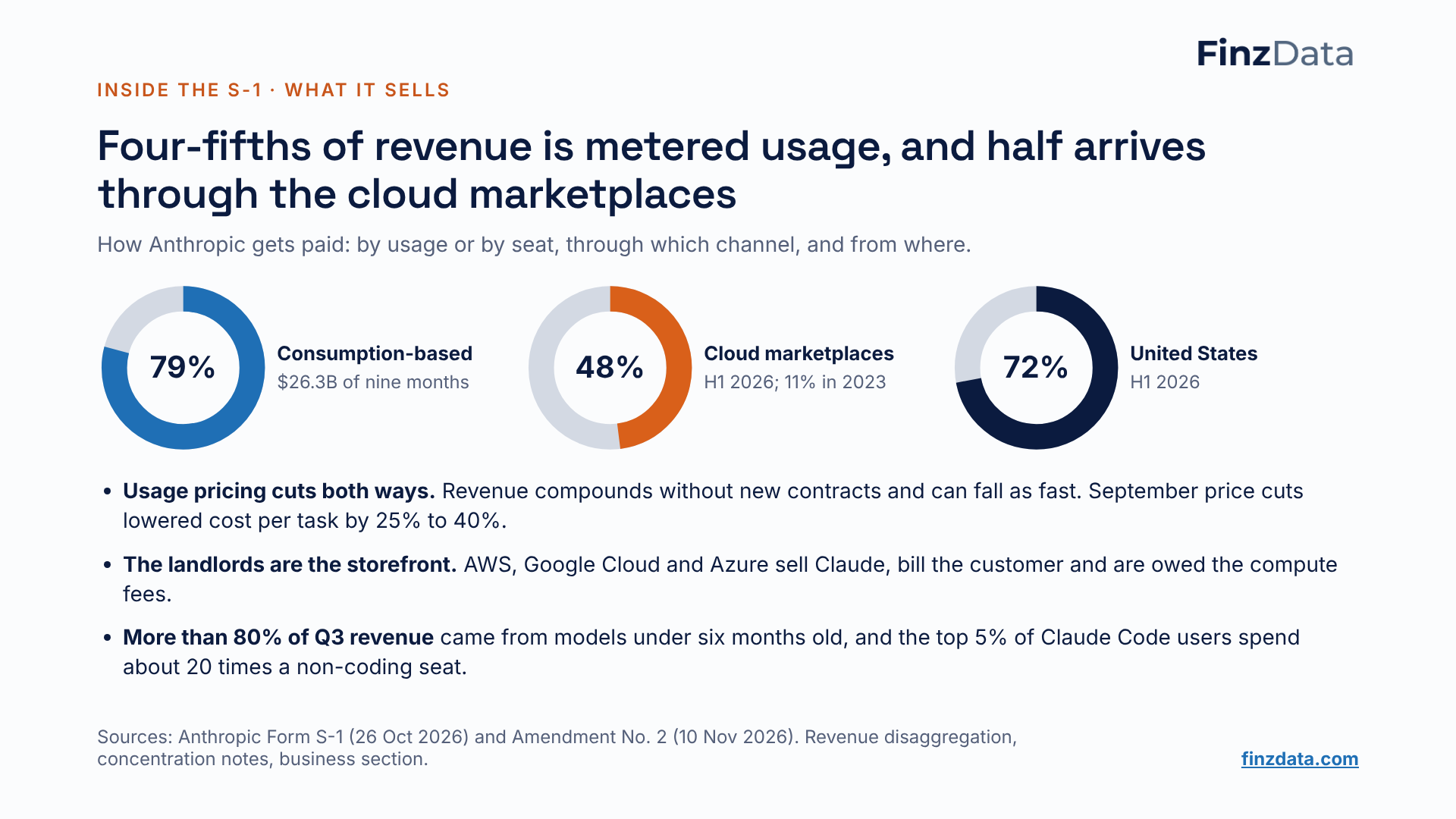
How Anthropic gets paid: by usage or by seat, through which channel, and from where.
Usage pricing cuts both ways. Revenue compounds without new contracts and can fall as fast. September price cuts lowered cost per task by 25% to 40%.
The landlords are the storefront. AWS, Google Cloud and Azure sell Claude, bill the customer and are owed the compute fees.
More than 80% of Q3 revenue came from models under six months old, and the top 5% of Claude Code users spend about 20 times a non-coding seat.
Sources: Anthropic Form S-1 (26 Oct 2026) and Amendment No. 2 (10 Nov 2026). Revenue disaggregation, concentration notes, business section.
6. Large customers grew from about 200 to 11,900 in 21 months; no active-user count is given
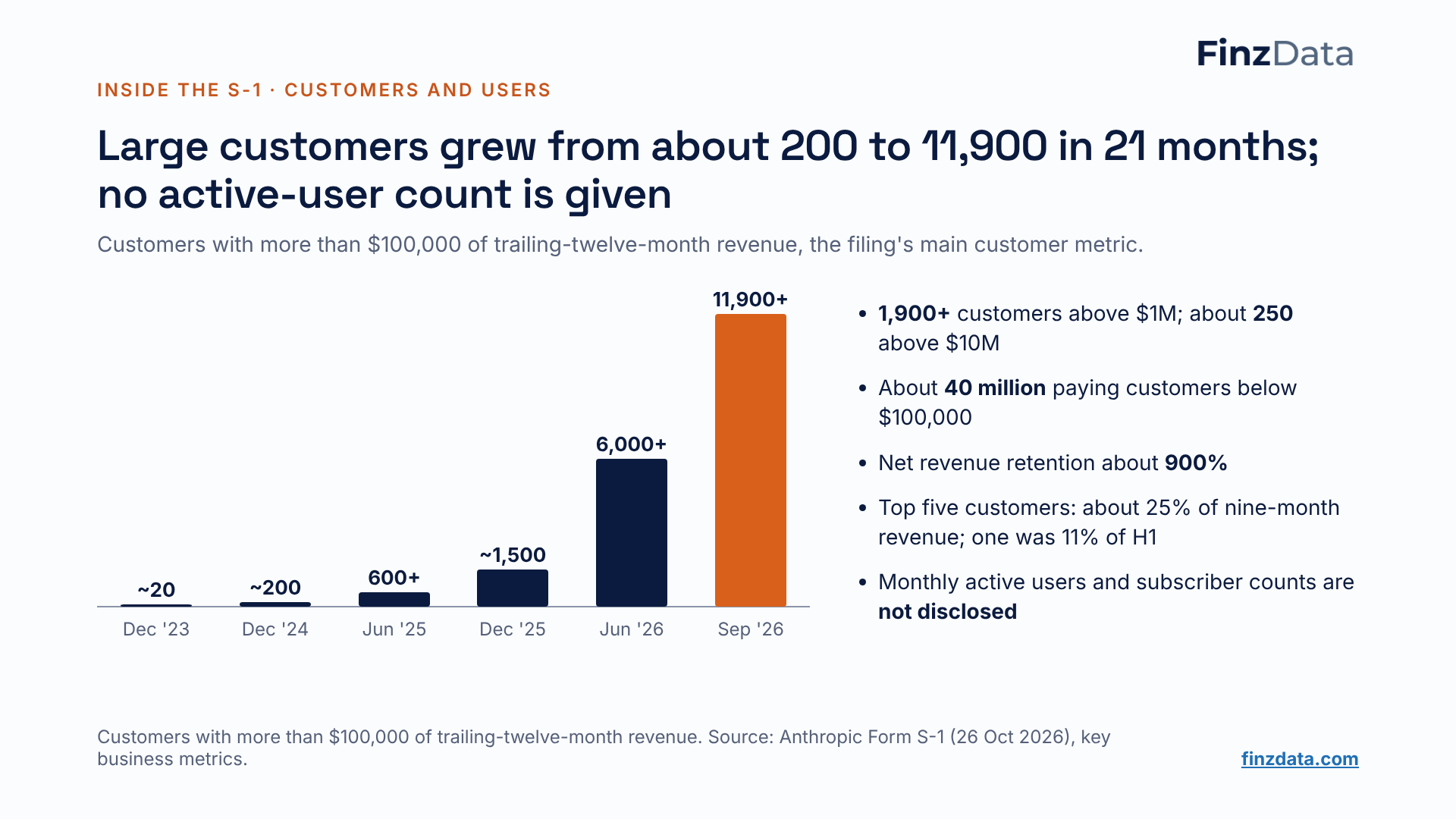
Customers with more than $100,000 of trailing-twelve-month revenue, the filing's main customer metric.
1,900+ customers above $1M; about 250 above $10M
About 40 million paying customers below $100,000
Net revenue retention about 900%
Top five customers: about 25% of nine-month revenue; one was 11% of H1
Monthly active users and subscriber counts are not disclosed
Customers with more than $100,000 of trailing-twelve-month revenue. Source: Anthropic Form S-1 (26 Oct 2026), key business metrics.
7. Compute fell from 251% of revenue to 48%, then rose to 58% in Q3 as spending stepped up
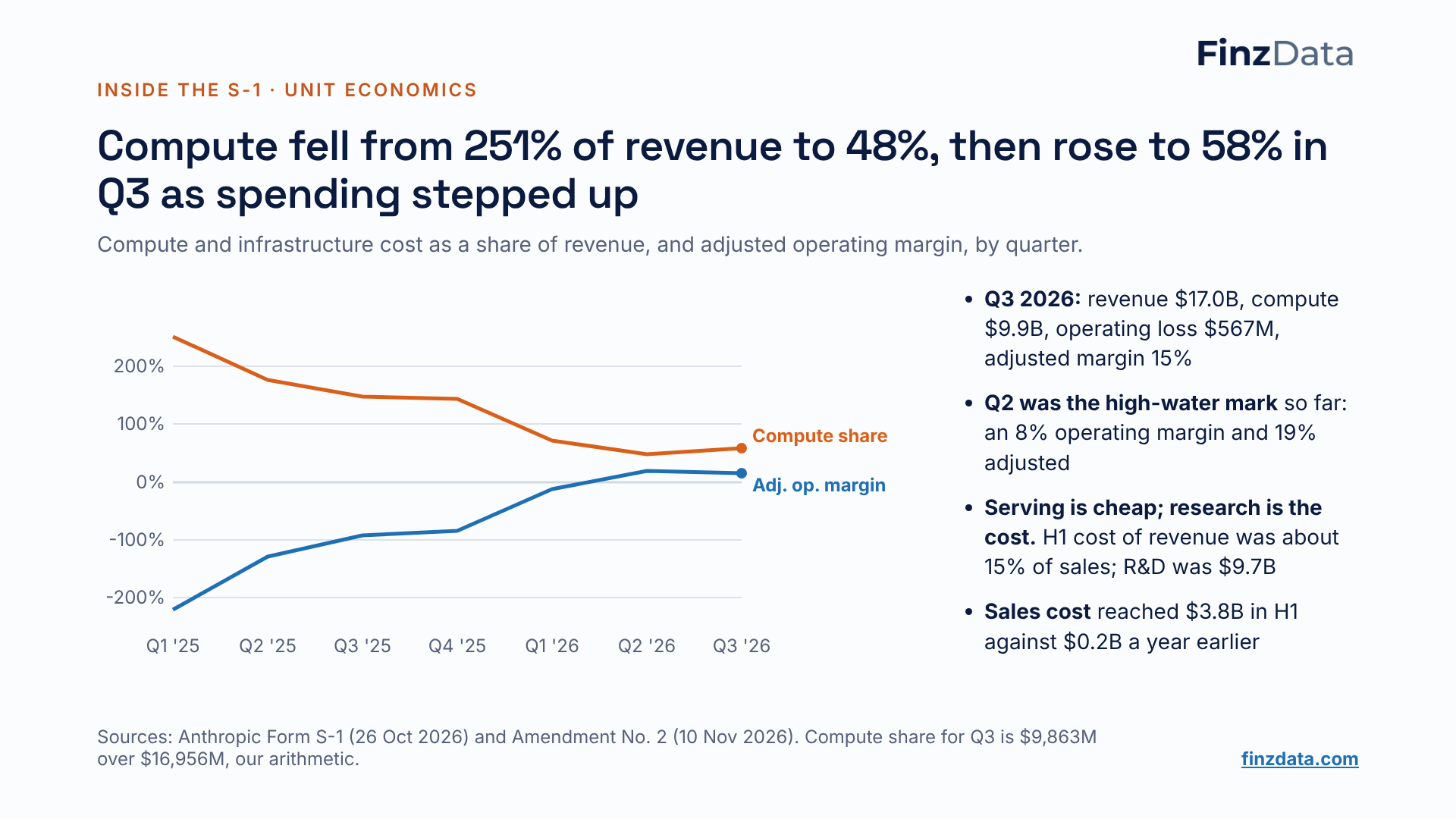
Compute and infrastructure cost as a share of revenue, and adjusted operating margin, by quarter.
Q3 2026: revenue $17.0B, compute $9.9B, operating loss $567M, adjusted margin 15%
Q2 was the high-water mark so far: an 8% operating margin and 19% adjusted
Serving is cheap; research is the cost. H1 cost of revenue was about 15% of sales; R&D was $9.7B
Sales cost reached $3.8B in H1 against $0.2B a year earlier
Sources: Anthropic Form S-1 (26 Oct 2026) and Amendment No. 2 (10 Nov 2026). Compute share for Q3 is $9,863M over $16,956M, our arithmetic.
8. Operations turned cash-positive in 2026; the $132B on the balance sheet came from investors
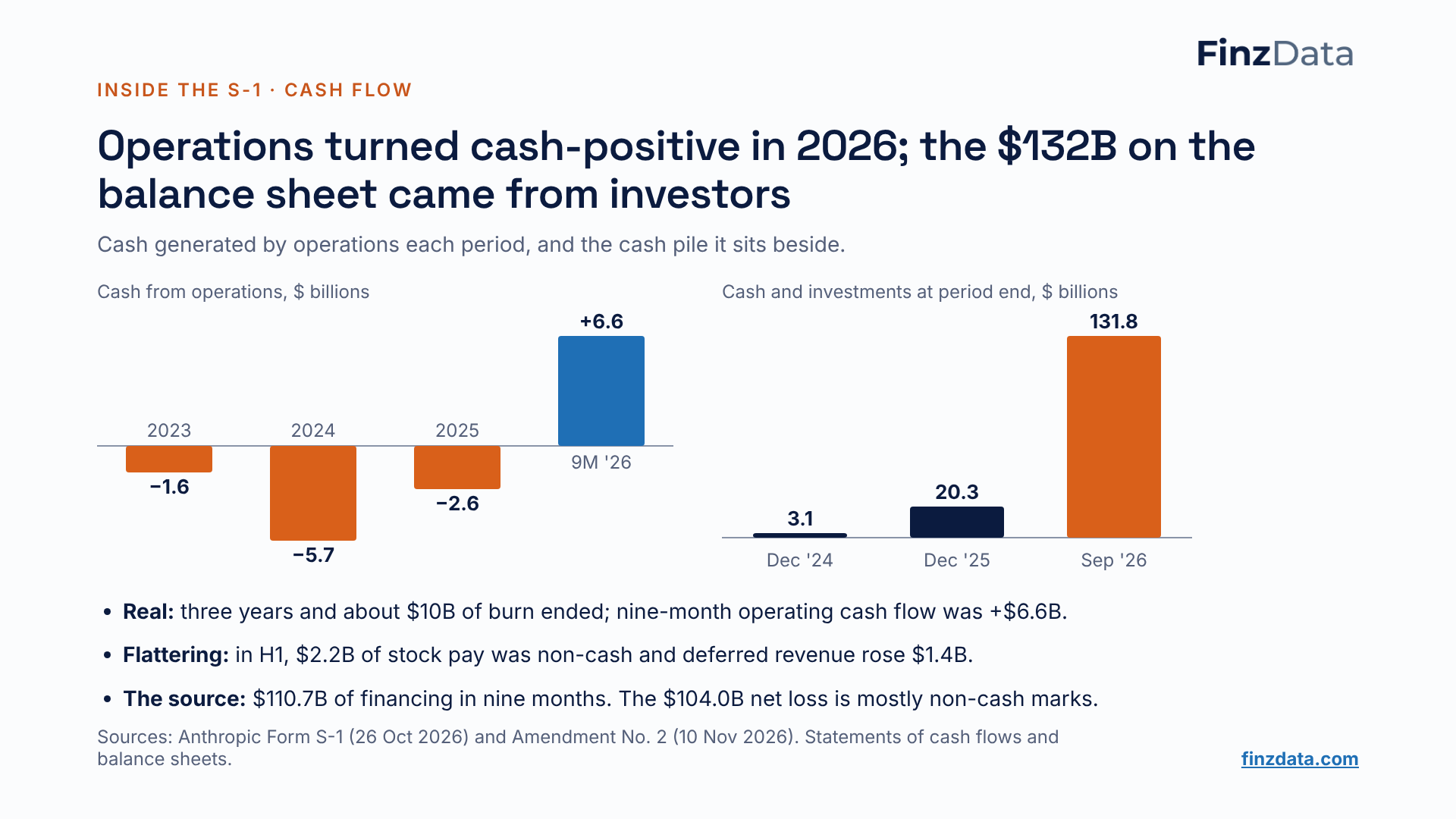
Cash generated by operations each period, and the cash pile it sits beside.
Real: three years and about $10B of burn ended; nine-month operating cash flow was +$6.6B.
Flattering: in H1, $2.2B of stock pay was non-cash and deferred revenue rose $1.4B.
The source: $110.7B of financing in nine months. The $104.0B net loss is mostly non-cash marks.
Sources: Anthropic Form S-1 (26 Oct 2026) and Amendment No. 2 (10 Nov 2026). Statements of cash flows and balance sheets.
9. The burn is contractual and still ahead: $70.7B falls due in the next twelve months
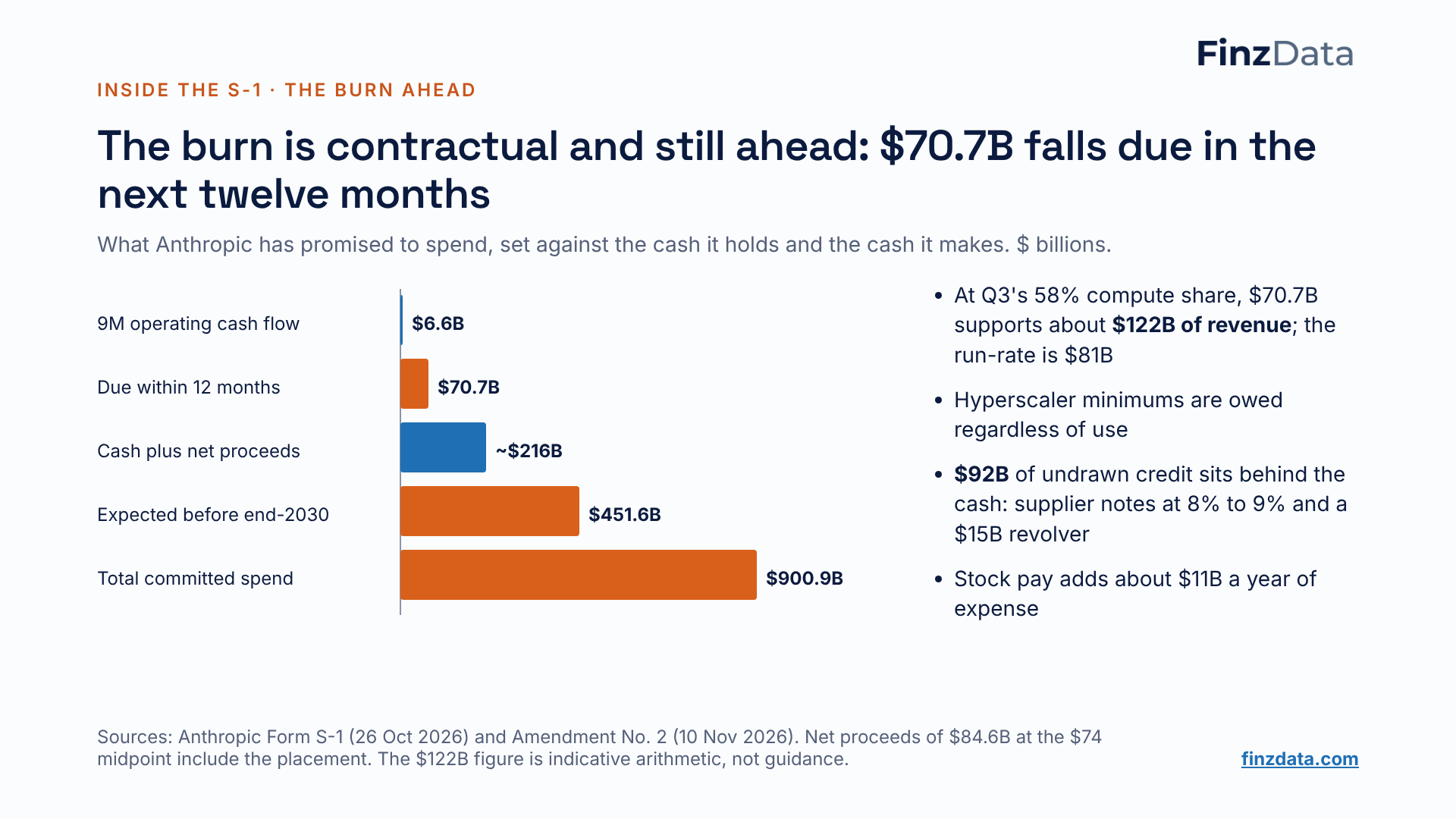
What Anthropic has promised to spend, set against the cash it holds and the cash it makes. $ billions.
At Q3's 58% compute share, $70.7B supports about $122B of revenue; the run-rate is $81B
Hyperscaler minimums are owed regardless of use
$92B of undrawn credit sits behind the cash: supplier notes at 8% to 9% and a $15B revolver
Stock pay adds about $11B a year of expense
Sources: Anthropic Form S-1 (26 Oct 2026) and Amendment No. 2 (10 Nov 2026). Net proceeds of $84.6B at the $74 midpoint include the placement. The $122B figure is indicative arithmetic, not guidance.
10. The IPO range sits 19% to 32% above a private round done six months ago
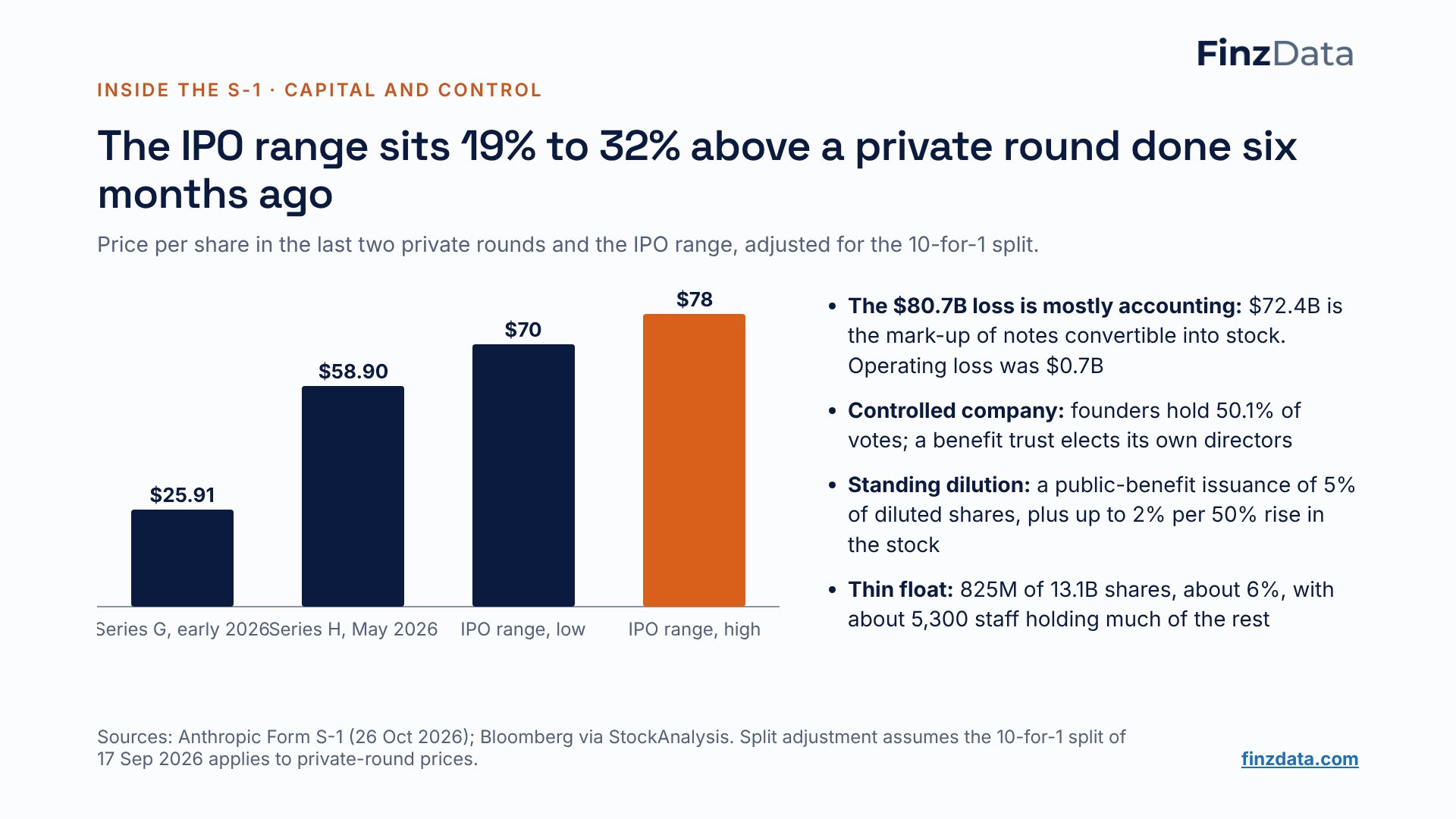
Price per share in the last two private rounds and the IPO range, adjusted for the 10-for-1 split.
The $80.7B loss is mostly accounting: $72.4B is the mark-up of notes convertible into stock. Operating loss was $0.7B
Controlled company: founders hold 50.1% of votes; a benefit trust elects its own directors
Standing dilution: a public-benefit issuance of 5% of diluted shares, plus up to 2% per 50% rise in the stock
Thin float: 825M of 13.1B shares, about 6%, with about 5,300 staff holding much of the rest
Sources: Anthropic Form S-1 (26 Oct 2026); Bloomberg via StockAnalysis. Split adjustment assumes the 10-for-1 split of 17 Sep 2026 applies to private-round prices.
11. On trailing sales Anthropic prices like Facebook in 2012, at a third of SpaceX's multiple
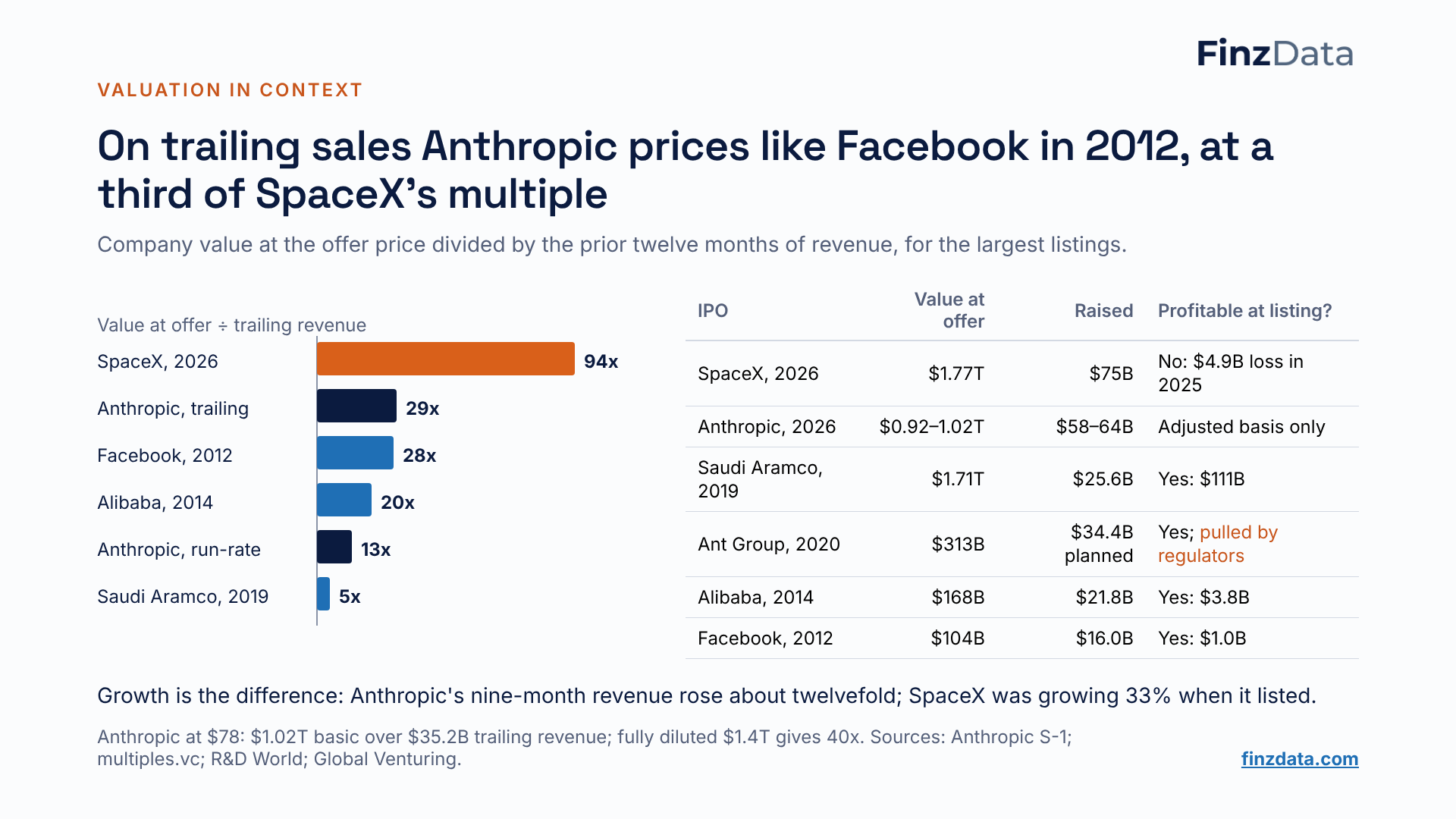
Company value at the offer price divided by the prior twelve months of revenue, for the largest listings.
Growth is the difference: Anthropic's nine-month revenue rose about twelvefold; SpaceX was growing 33% when it listed.
| IPO | Value at offer | Raised | Profitable at listing? |
|---|---|---|---|
| SpaceX, 2026 | $1.77T | $75B | No: $4.9B loss in 2025 |
| Anthropic, 2026 | $0.92–1.02T | $58–64B | Adjusted basis only |
| Saudi Aramco, 2019 | $1.71T | $25.6B | Yes: $111B |
| Ant Group, 2020 | $313B | $34.4B planned | Yes; pulled by regulators |
| Alibaba, 2014 | $168B | $21.8B | Yes: $3.8B |
| Facebook, 2012 | $104B | $16.0B | Yes: $1.0B |
Anthropic at $78: $1.02T basic over $35.2B trailing revenue; fully diluted $1.4T gives 40x. Sources: Anthropic S-1; multiples.vc; R&D World; Global Venturing.
12. Open models: named in one paragraph, answered with the frontier
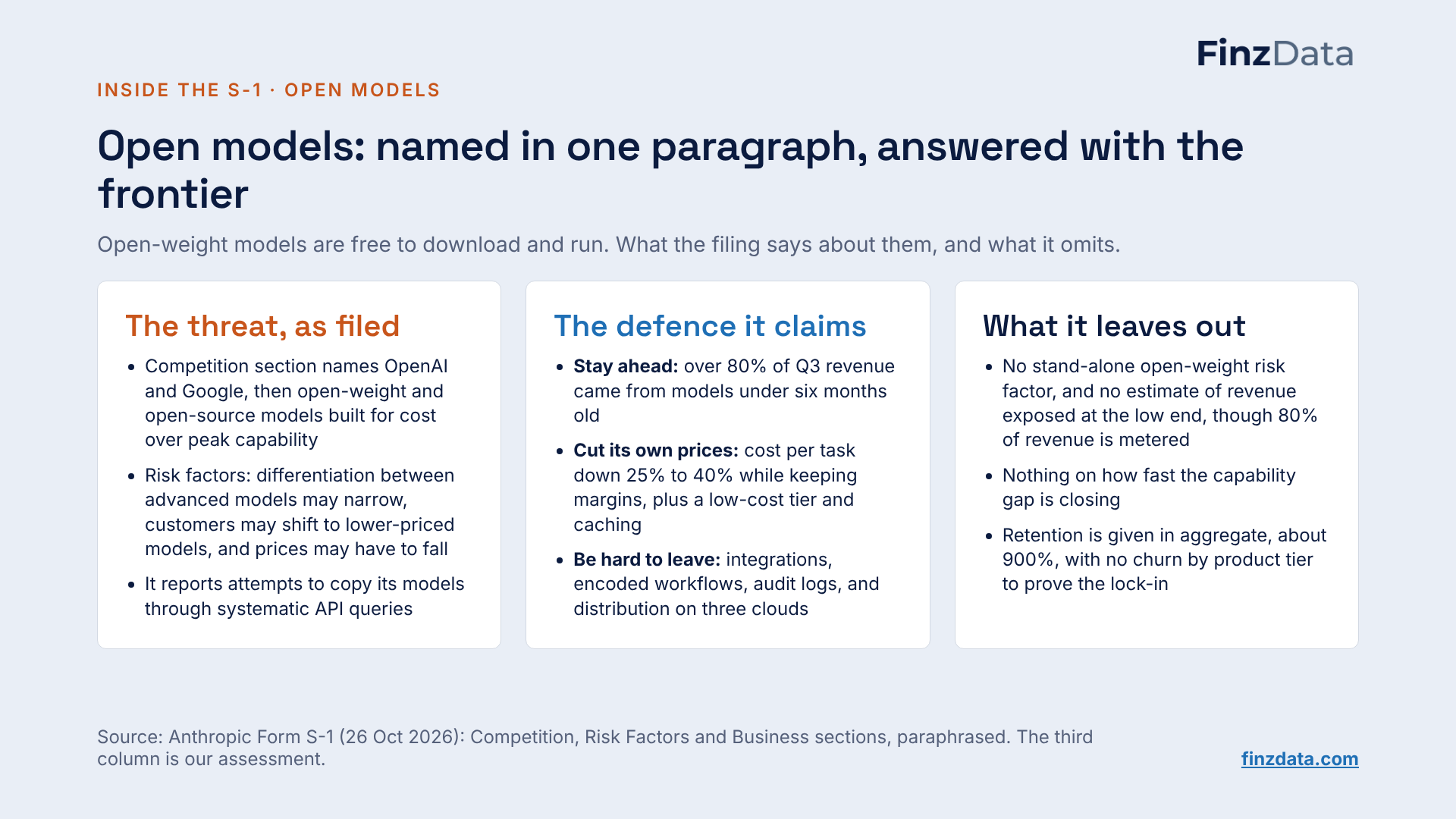
Open-weight models are free to download and run. What the filing says about them, and what it omits.
Competition section names OpenAI and Google, then open-weight and open-source models built for cost over peak capability
Risk factors: differentiation between advanced models may narrow, customers may shift to lower-priced models, and prices may have to fall
It reports attempts to copy its models through systematic API queries
Stay ahead: over 80% of Q3 revenue came from models under six months old
Cut its own prices: cost per task down 25% to 40% while keeping margins, plus a low-cost tier and caching
Be hard to leave: integrations, encoded workflows, audit logs, and distribution on three clouds
No stand-alone open-weight risk factor, and no estimate of revenue exposed at the low end, though 80% of revenue is metered
Nothing on how fast the capability gap is closing
Retention is given in aggregate, about 900%, with no churn by product tier to prove the lock-in
Source: Anthropic Form S-1 (26 Oct 2026): Competition, Risk Factors and Business sections, paraphrased. The third column is our assessment.
13. Open models are winning tokens, not dollars, and the pressure is at the low end
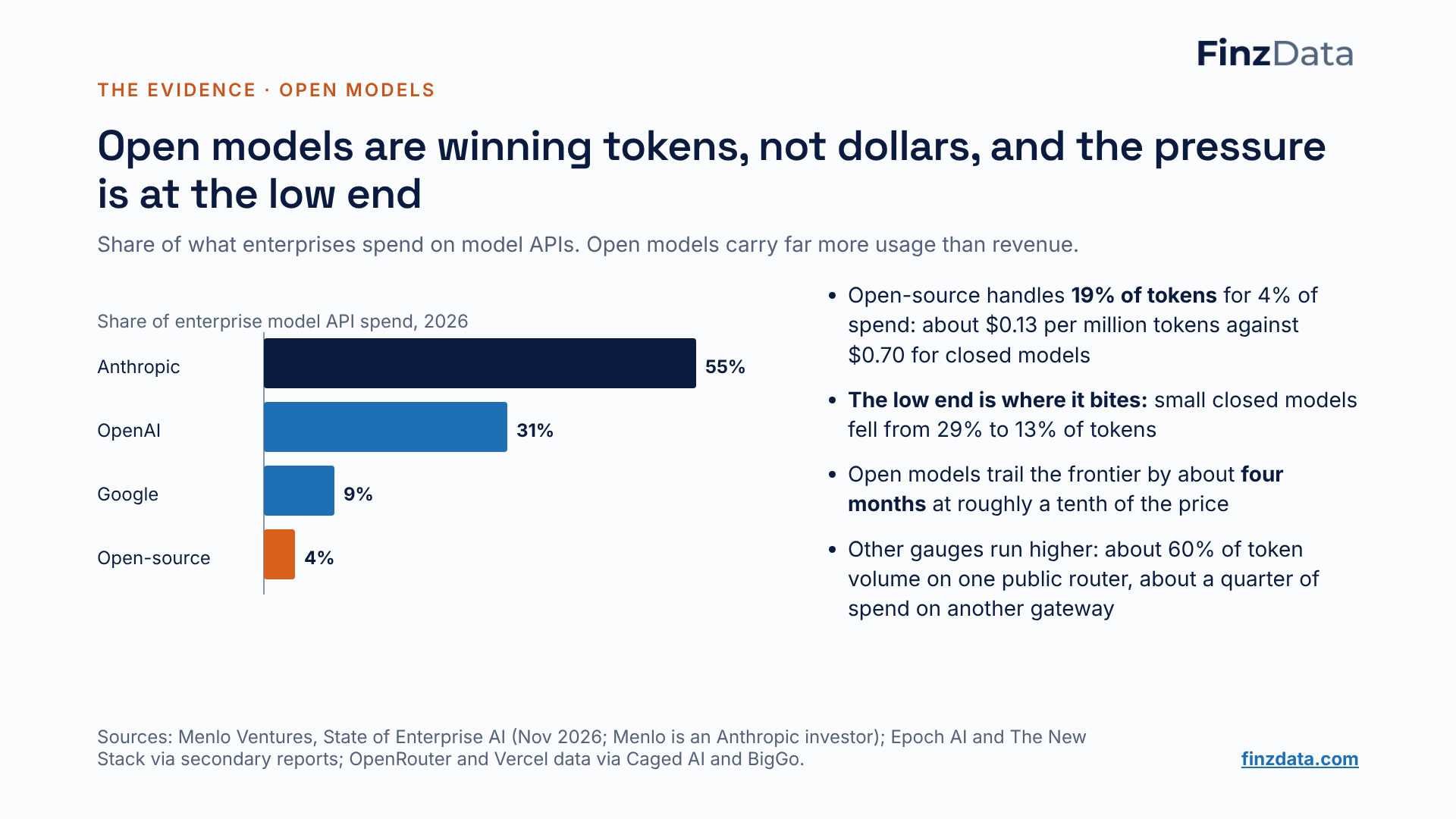
Share of what enterprises spend on model APIs. Open models carry far more usage than revenue.
Open-source handles 19% of tokens for 4% of spend: about $0.13 per million tokens against $0.70 for closed models
The low end is where it bites: small closed models fell from 29% to 13% of tokens
Open models trail the frontier by about four months at roughly a tenth of the price
Other gauges run higher: about 60% of token volume on one public router, about a quarter of spend on another gateway
Sources: Menlo Ventures, State of Enterprise AI (Nov 2026; Menlo is an Anthropic investor); Epoch AI and The New Stack via secondary reports; OpenRouter and Vercel data via Caged AI and BigGo.
14. Anthropic owes more for Google-designed chips than for everything built on Nvidia
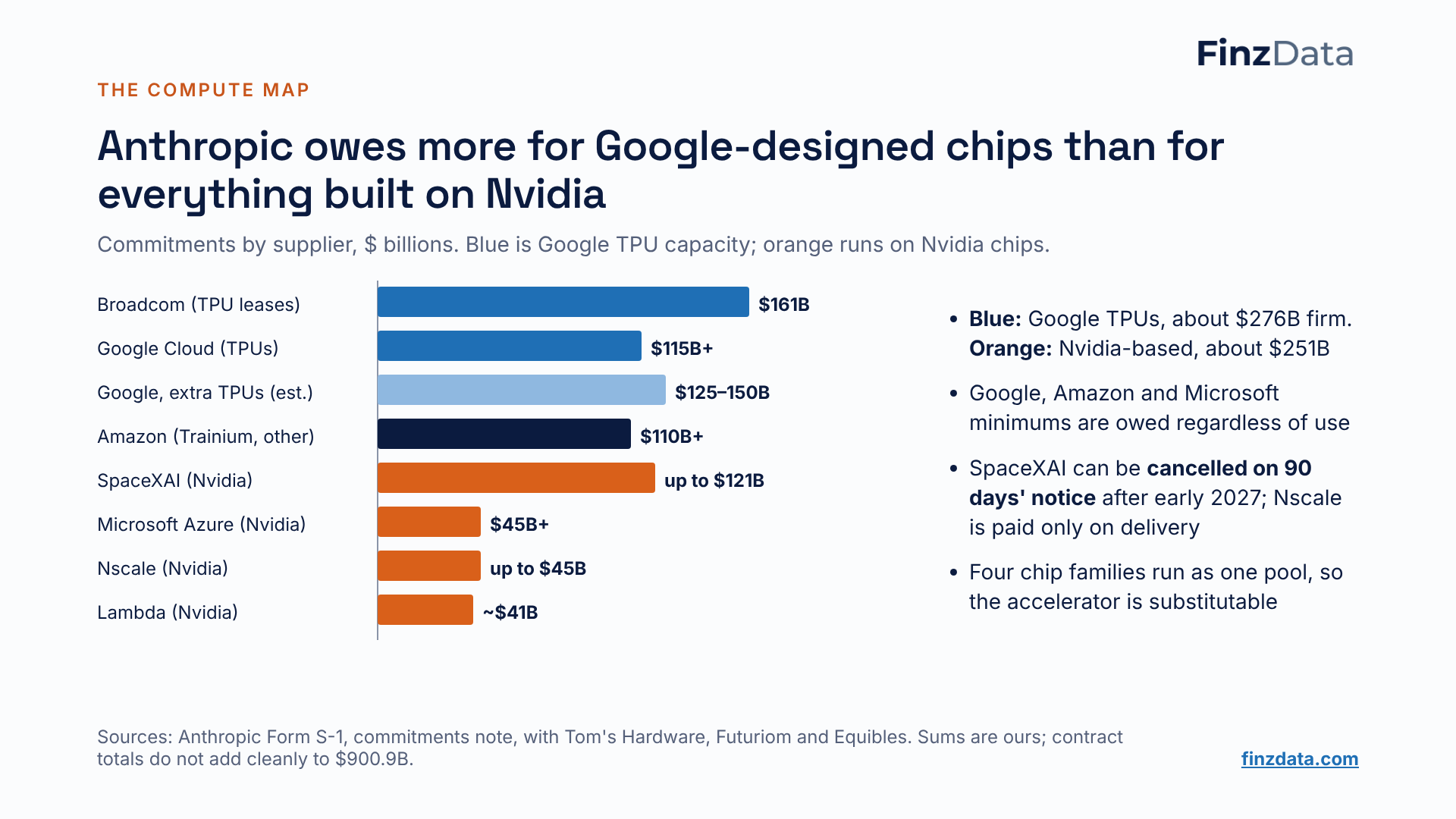
Commitments by supplier, $ billions. Blue is Google TPU capacity; orange runs on Nvidia chips.
Blue: Google TPUs, about $276B firm. Orange: Nvidia-based, about $251B
Google, Amazon and Microsoft minimums are owed regardless of use
SpaceXAI can be cancelled on 90 days' notice after early 2027; Nscale is paid only on delivery
Four chip families run as one pool, so the accelerator is substitutable
Sources: Anthropic Form S-1, commitments note, with Tom's Hardware, Futuriom and Equibles. Sums are ours; contract totals do not add cleanly to $900.9B.
15. The last record IPO marked the high in semis within six sessions
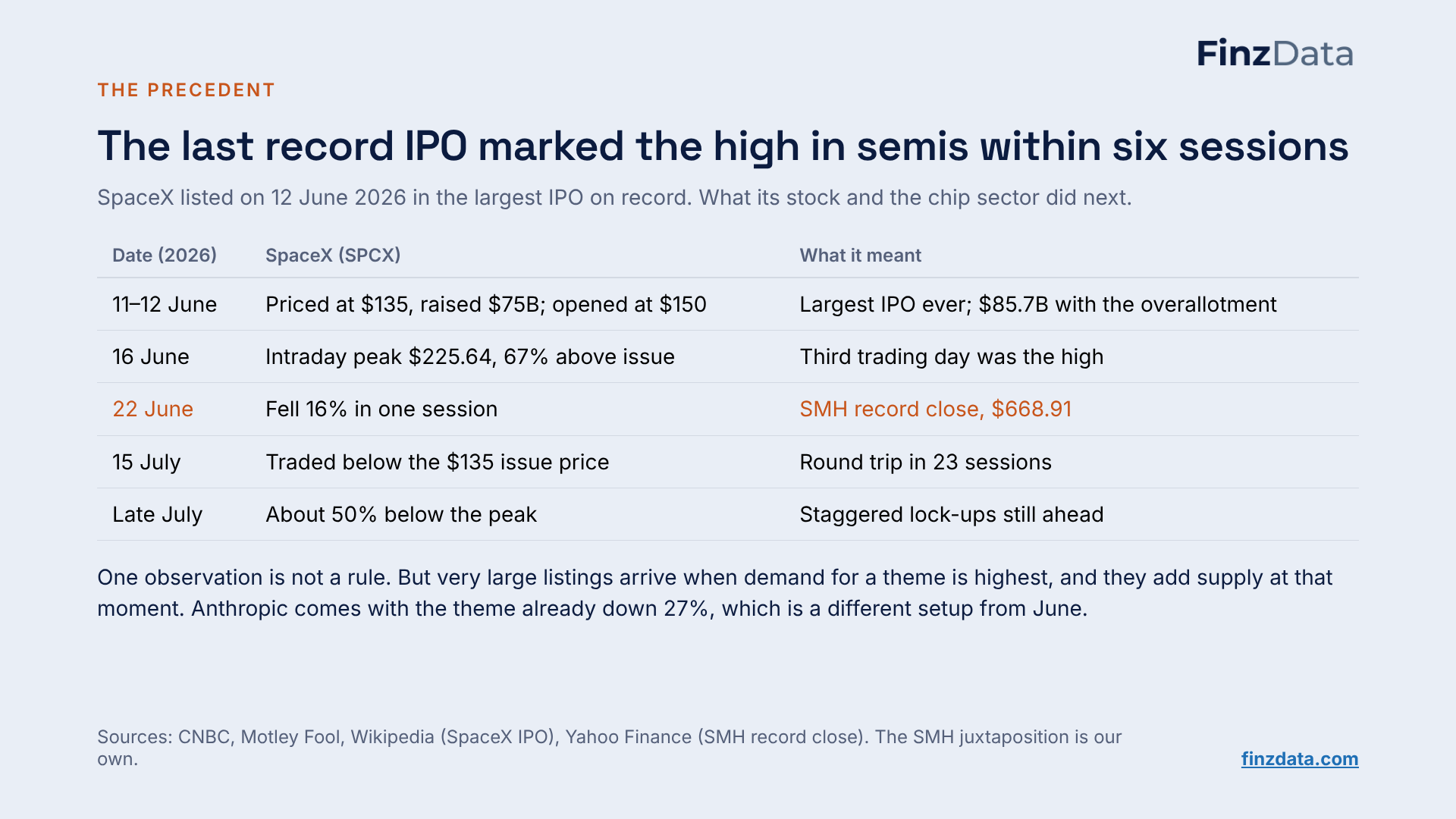
SpaceX listed on 12 June 2026 in the largest IPO on record. What its stock and the chip sector did next.
One observation is not a rule. But very large listings arrive when demand for a theme is highest, and they add supply at that moment. Anthropic comes with the theme already down 27%, which is a different setup from June.
| Date (2026) | SpaceX (SPCX) | What it meant |
|---|---|---|
| 11–12 June | Priced at $135, raised $75B; opened at $150 | Largest IPO ever; $85.7B with the overallotment |
| 16 June | Intraday peak $225.64, 67% above issue | Third trading day was the high |
| 22 June | Fell 16% in one session | SMH record close, $668.91 |
| 15 July | Traded below the $135 issue price | Round trip in 23 sessions |
| Late July | About 50% below the peak | Staggered lock-ups still ahead |
Sources: CNBC, Motley Fool, Wikipedia (SpaceX IPO), Yahoo Finance (SMH record close). The SMH juxtaposition is our own.
16. Semis ran 55% into SpaceX's listing and fell 17% after; Anthropic arrives with them already down 14%
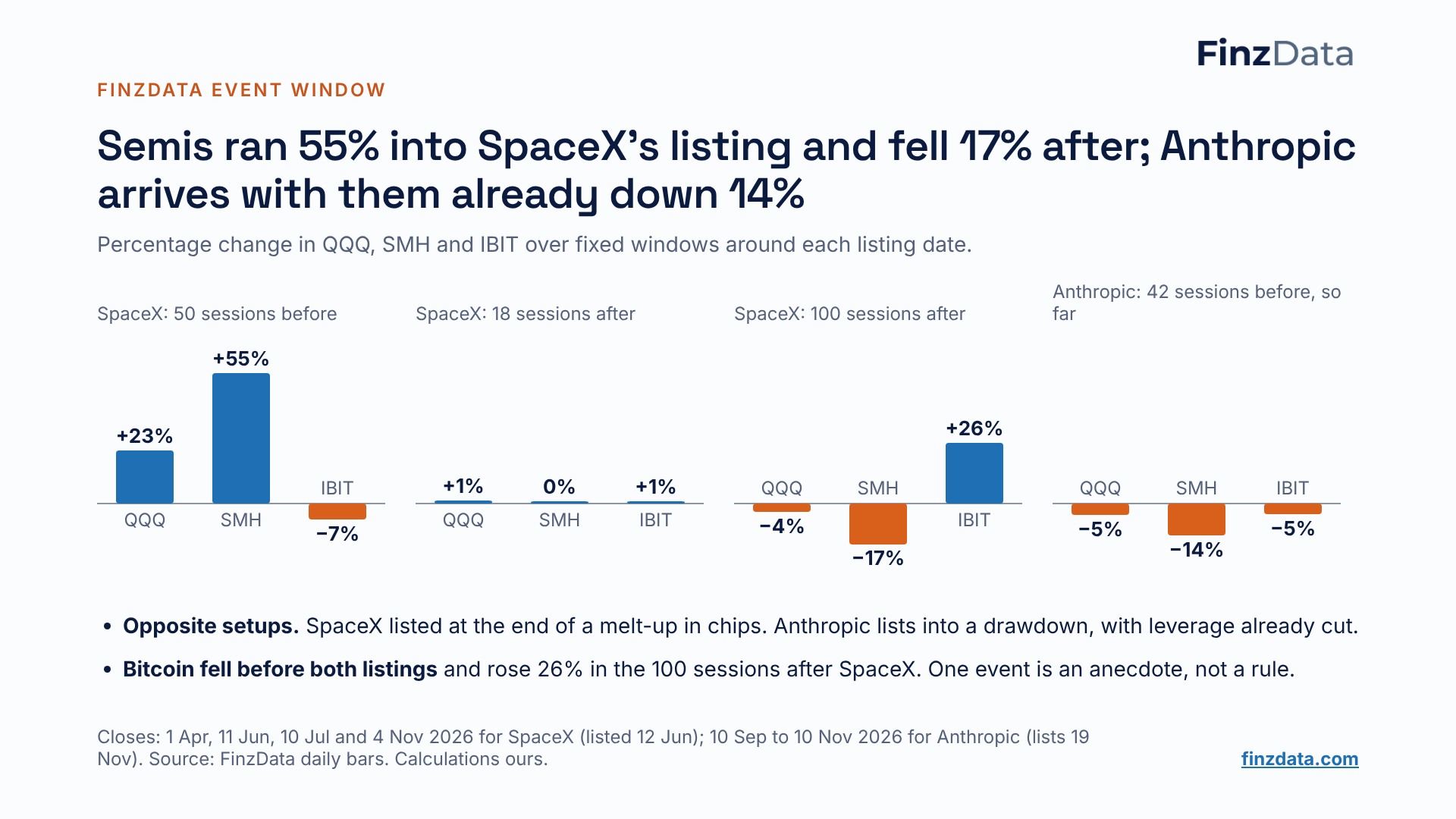
Percentage change in QQQ, SMH and IBIT over fixed windows around each listing date.
Opposite setups. SpaceX listed at the end of a melt-up in chips. Anthropic lists into a drawdown, with leverage already cut.
Bitcoin fell before both listings and rose 26% in the 100 sessions after SpaceX. One event is an anecdote, not a rule.
Closes: 1 Apr, 11 Jun, 10 Jul and 4 Nov 2026 for SpaceX (listed 12 Jun); 10 Sep to 10 Nov 2026 for Anthropic (lists 19 Nov). Source: FinzData daily bars. Calculations ours.
17. Index rules put a passive bid under ANT in December, funded by selling everything else
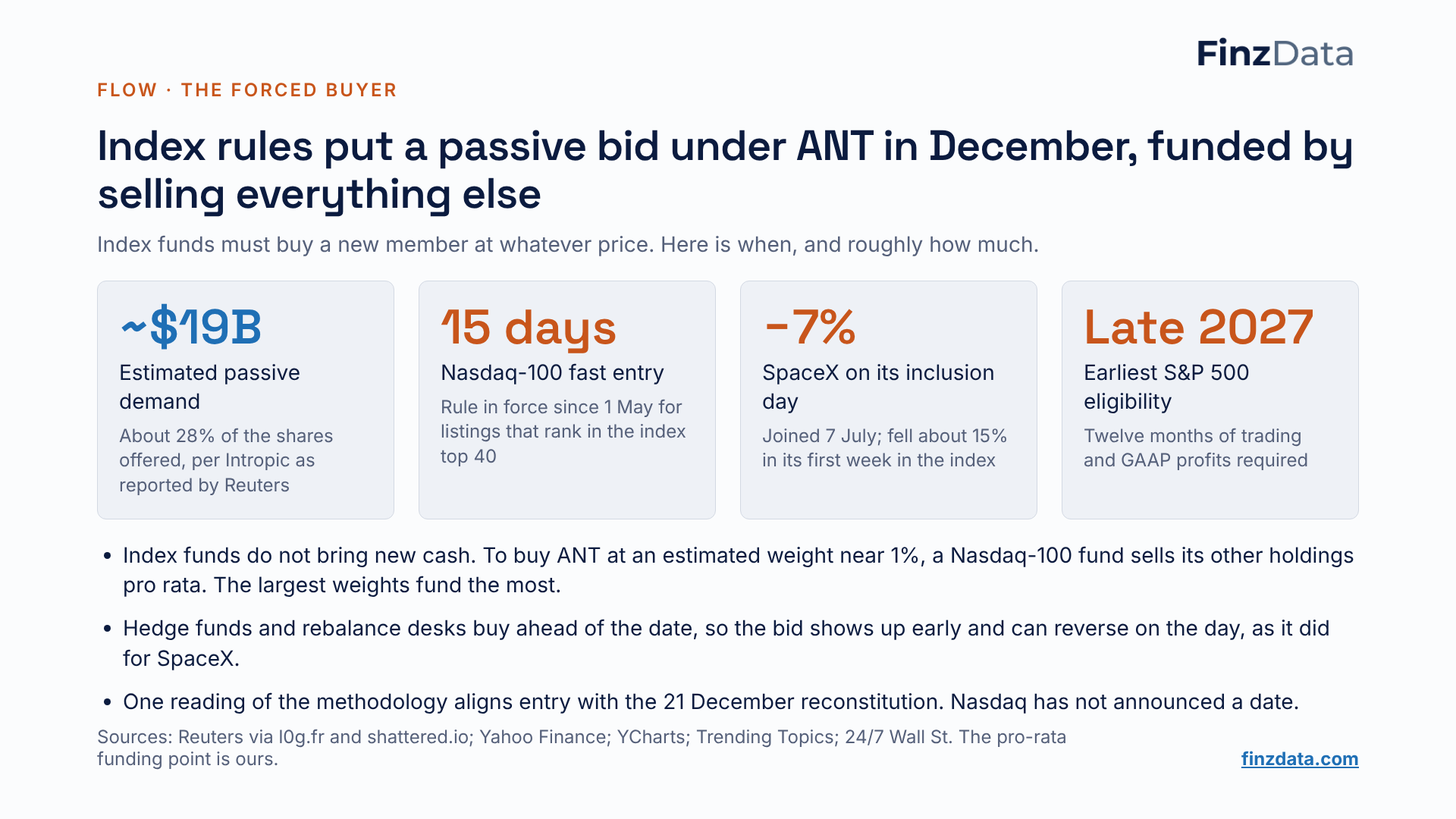
Index funds must buy a new member at whatever price. Here is when, and roughly how much.
Index funds do not bring new cash. To buy ANT at an estimated weight near 1%, a Nasdaq-100 fund sells its other holdings pro rata. The largest weights fund the most.
Hedge funds and rebalance desks buy ahead of the date, so the bid shows up early and can reverse on the day, as it did for SpaceX.
One reading of the methodology aligns entry with the 21 December reconstitution. Nasdaq has not announced a date.
Estimated passive demand
Nasdaq-100 fast entry
SpaceX on its inclusion day
Earliest S&P 500 eligibility
Sources: Reuters via l0g.fr and shattered.io; Yahoo Finance; YCharts; Trending Topics; 24/7 Wall St. The pro-rata funding point is ours.
18. Only 6% floats on day one; the first insider release lands days before likely index entry
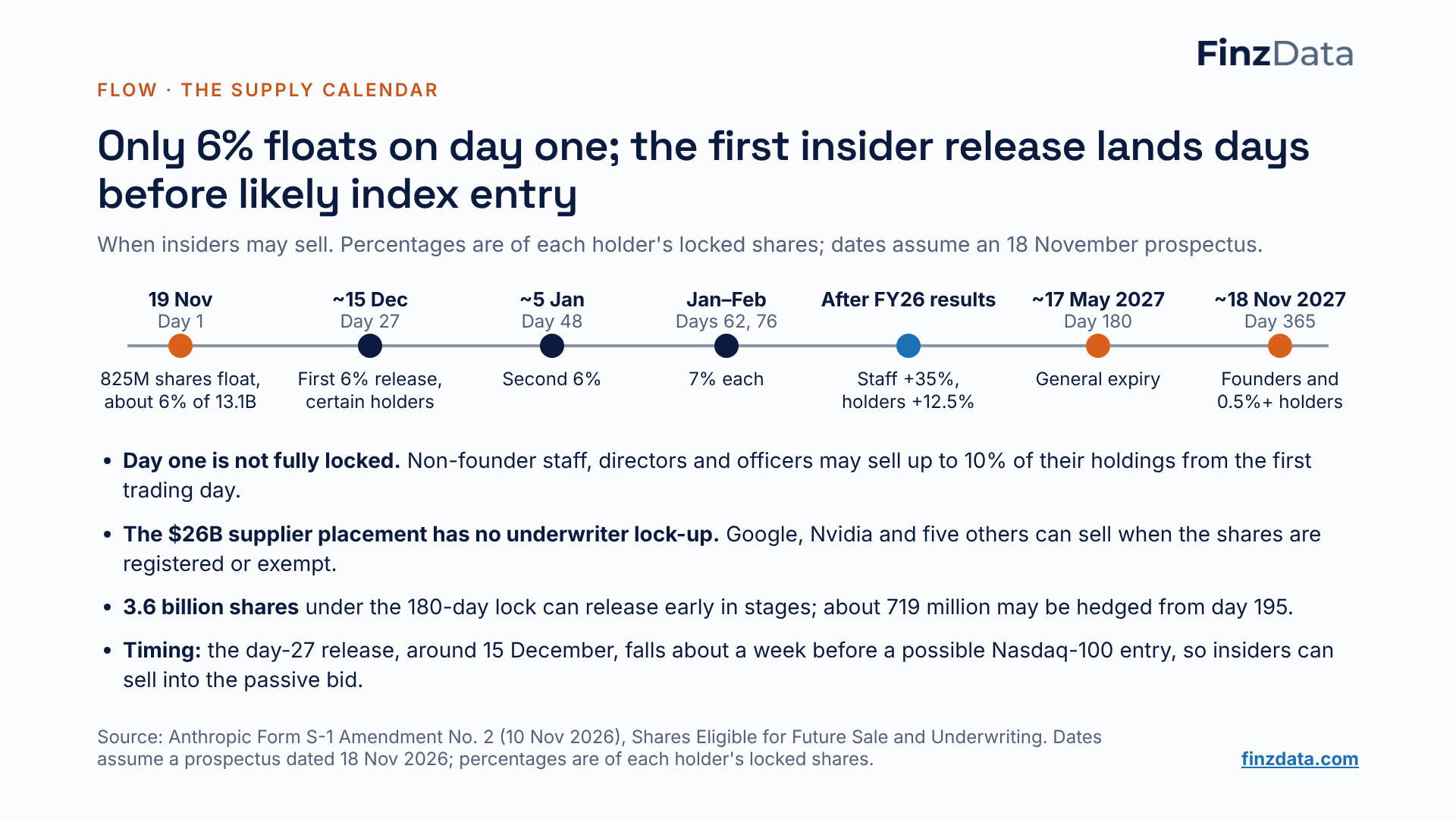
When insiders may sell. Percentages are of each holder's locked shares; dates assume an 18 November prospectus.
Day one is not fully locked. Non-founder staff, directors and officers may sell up to 10% of their holdings from the first trading day.
The $26B supplier placement has no underwriter lock-up. Google, Nvidia and five others can sell when the shares are registered or exempt.
3.6 billion shares under the 180-day lock can release early in stages; about 719 million may be hedged from day 195.
Timing: the day-27 release, around 15 December, falls about a week before a possible Nasdaq-100 entry, so insiders can sell into the passive bid.
Source: Anthropic Form S-1 Amendment No. 2 (10 Nov 2026), Shares Eligible for Future Sale and Underwriting. Dates assume a prospectus dated 18 Nov 2026; percentages are of each holder's locked shares.
19. The November crash was a deleveraging event; much of the forced selling is done
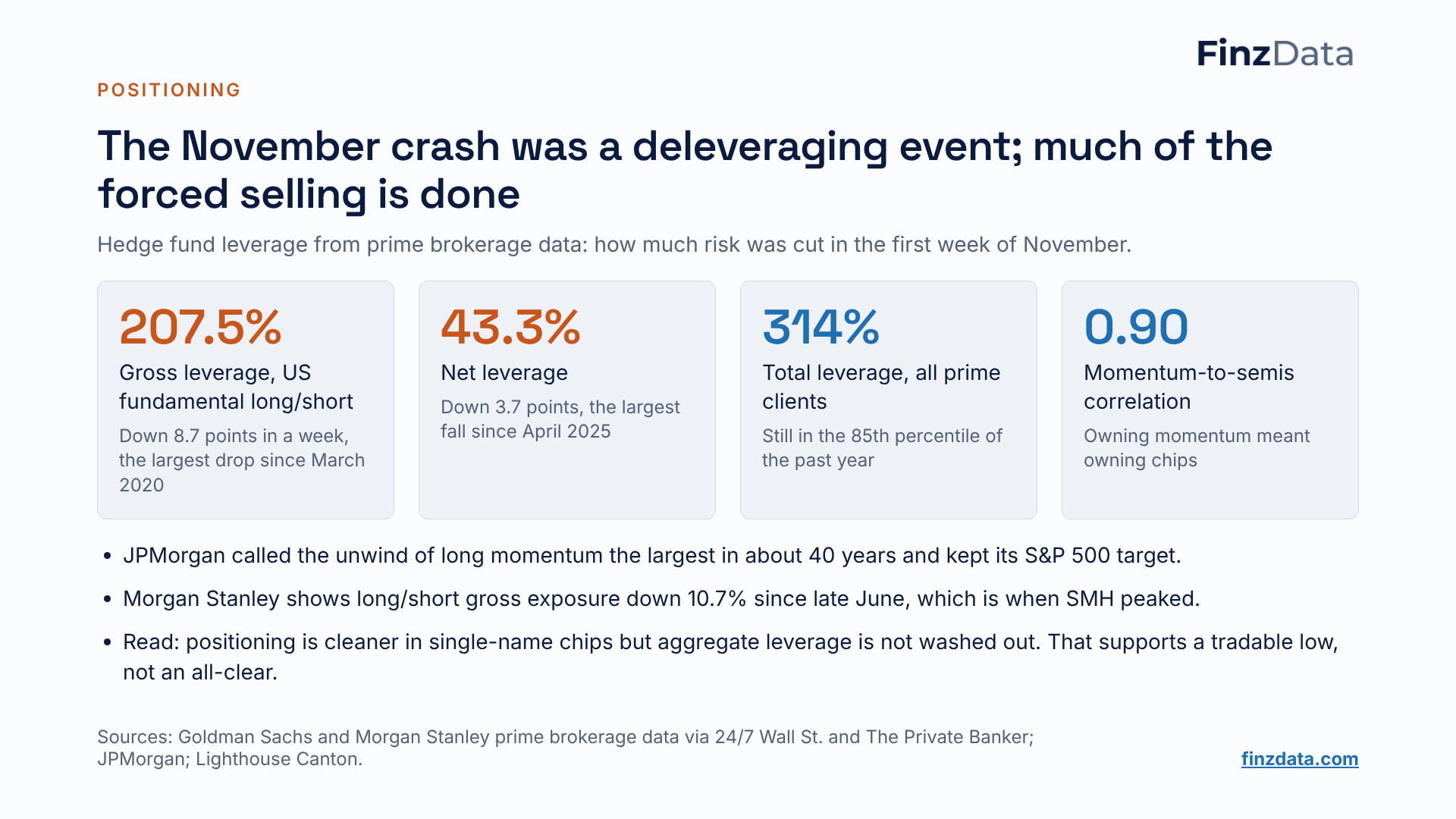
Hedge fund leverage from prime brokerage data: how much risk was cut in the first week of November.
JPMorgan called the unwind of long momentum the largest in about 40 years and kept its S&P 500 target.
Morgan Stanley shows long/short gross exposure down 10.7% since late June, which is when SMH peaked.
Read: positioning is cleaner in single-name chips but aggregate leverage is not washed out. That supports a tradable low, not an all-clear.
Gross leverage, US fundamental long/short
Net leverage
Total leverage, all prime clients
Momentum-to-semis correlation
Sources: Goldman Sachs and Morgan Stanley prime brokerage data via 24/7 Wall St. and The Private Banker; JPMorgan; Lighthouse Canton.
20. Semis peaked ten days after the last record IPO; Nvidia made one more high; Bitcoin rolled over last
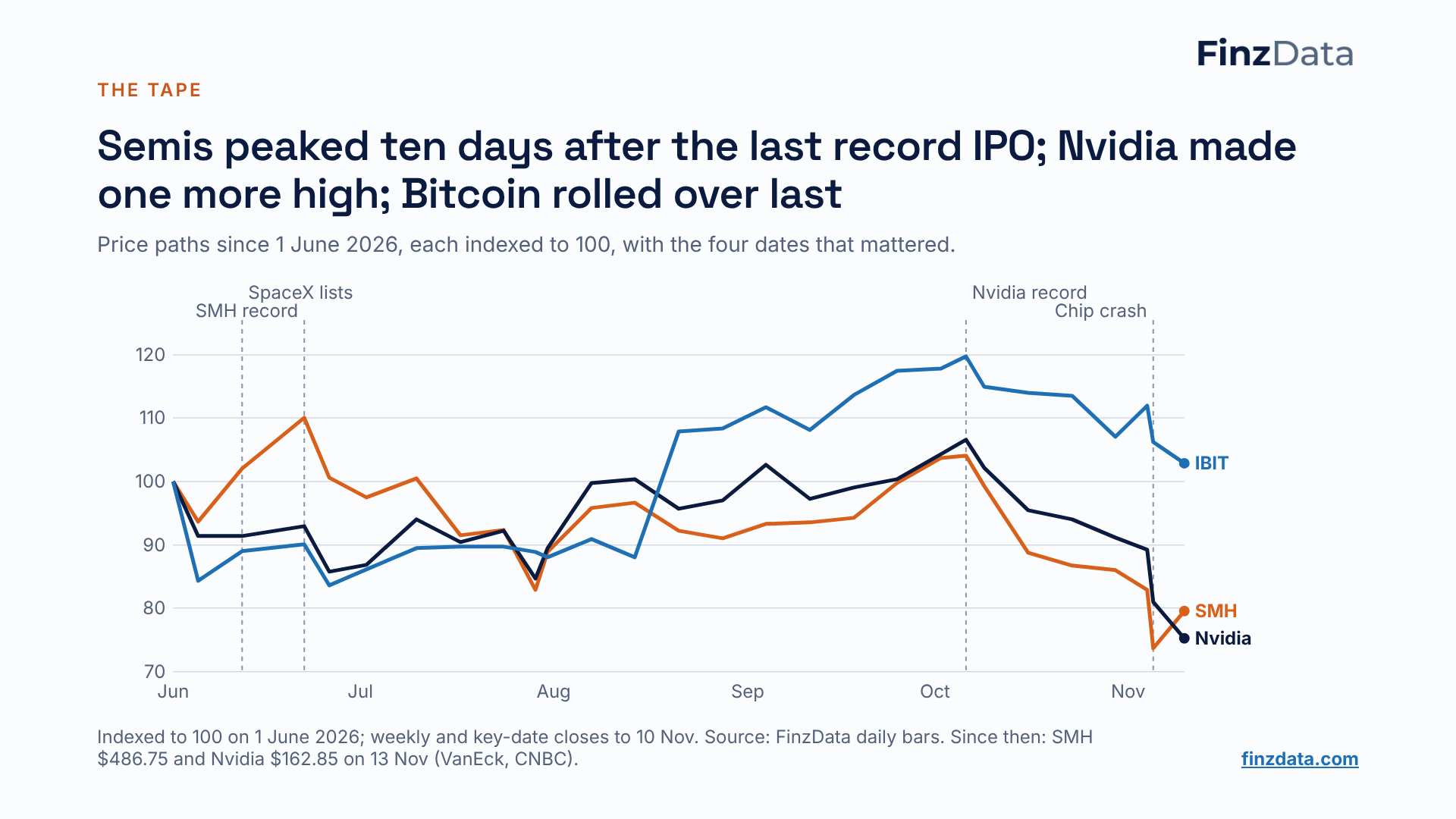
Price paths since 1 June 2026, each indexed to 100, with the four dates that mattered.
Indexed to 100 on 1 June 2026; weekly and key-date closes to 10 Nov. Source: FinzData daily bars. Since then: SMH $486.75 and Nvidia $162.85 on 13 Nov (VanEck, CNBC).
21. Neoclouds halved, memory fell hardest, and Nvidia is negative on the year
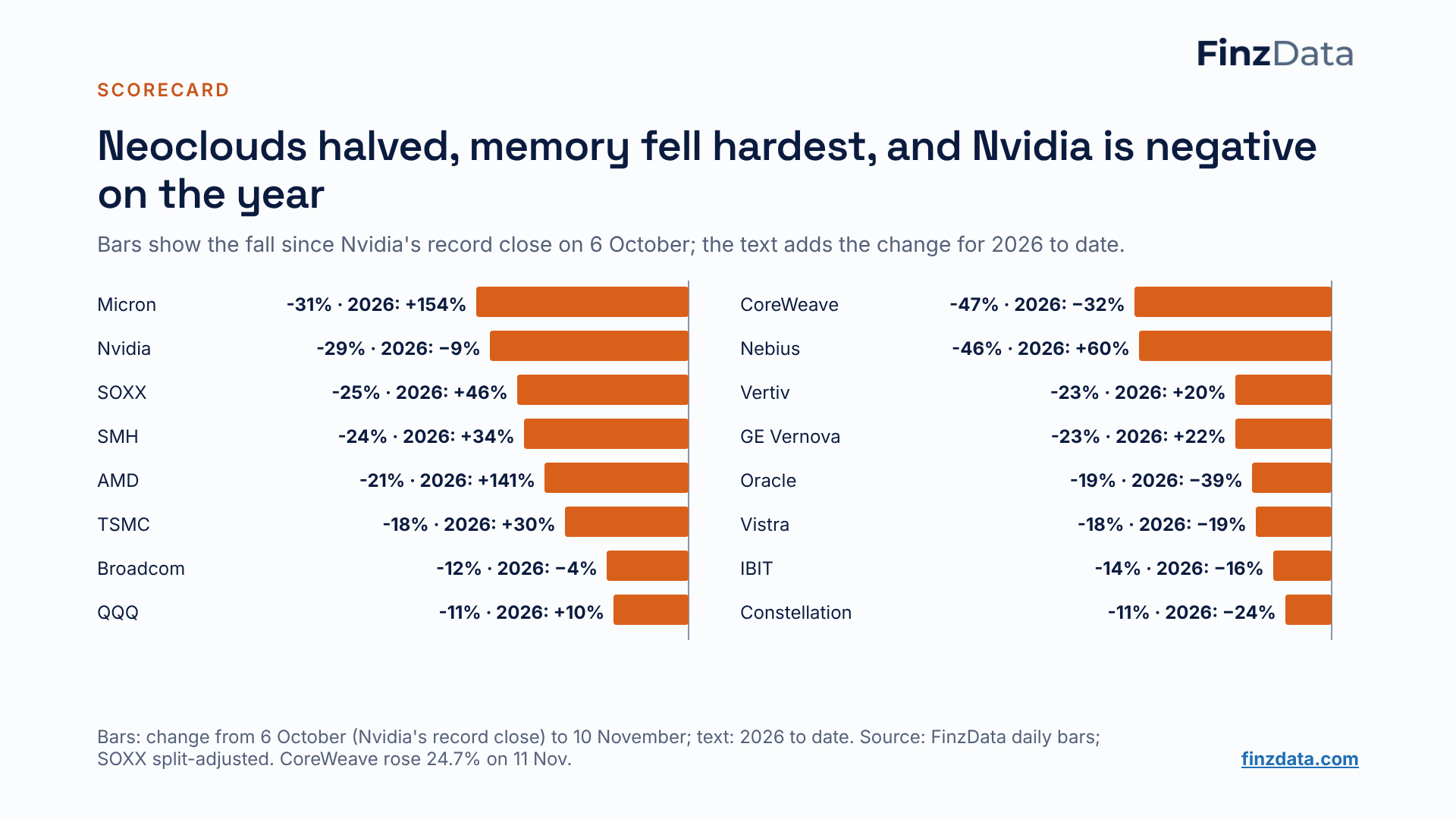
Bars show the fall since Nvidia's record close on 6 October; the text adds the change for 2026 to date.
Bars: change from 6 October (Nvidia's record close) to 10 November; text: 2026 to date. Source: FinzData daily bars; SOXX split-adjusted. CoreWeave rose 24.7% on 11 Nov.
22. Dealers are short gamma in SMH and Nvidia into the event week, which amplifies moves both ways
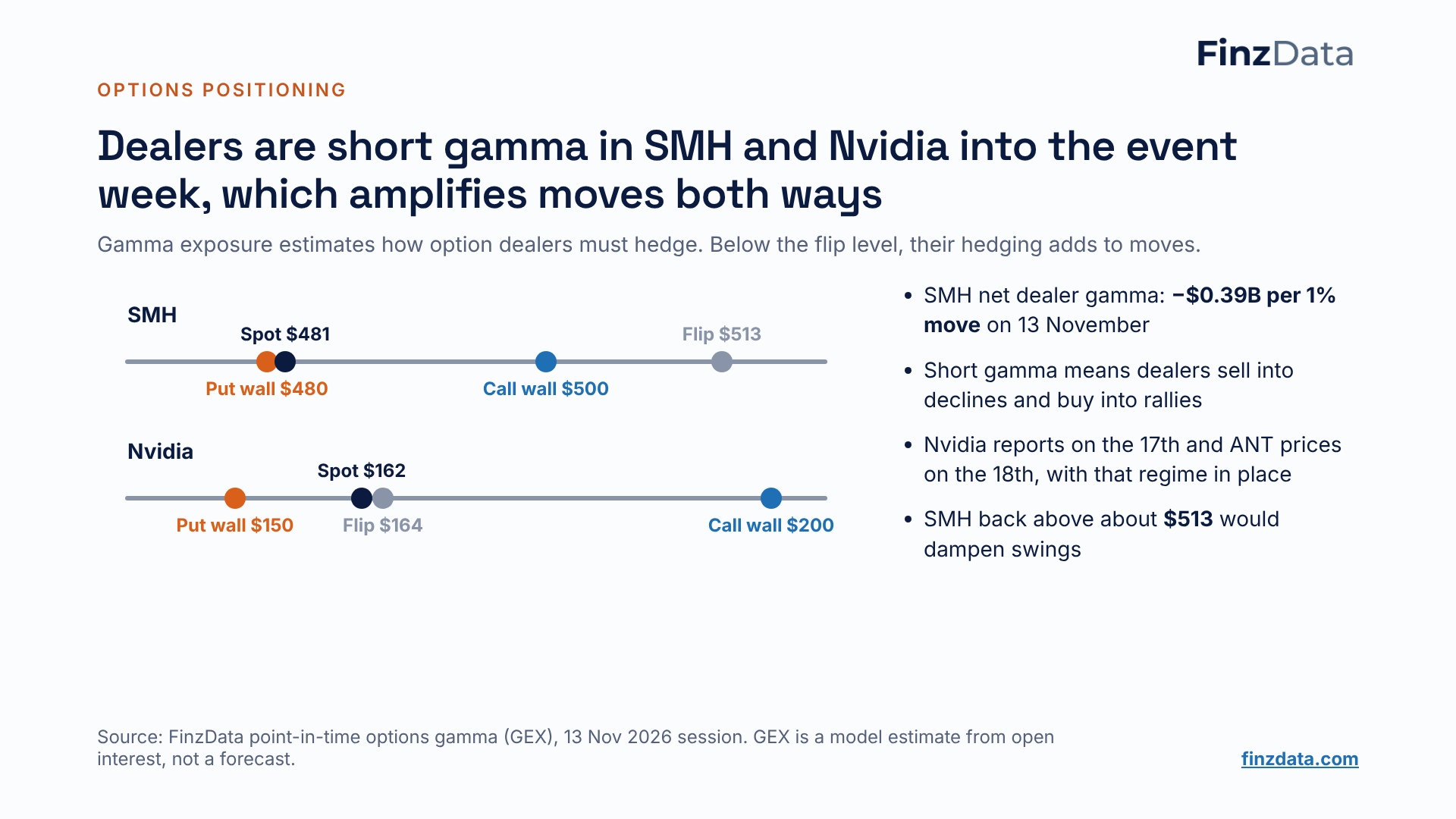
Gamma exposure estimates how option dealers must hedge. Below the flip level, their hedging adds to moves.
SMH net dealer gamma: −$0.39B per 1% move on 13 November
Short gamma means dealers sell into declines and buy into rallies
Nvidia reports on the 17th and ANT prices on the 18th, with that regime in place
SMH back above about $513 would dampen swings
Source: FinzData point-in-time options gamma (GEX), 13 Nov 2026 session. GEX is a model estimate from open interest, not a forecast.
23. SMH is 27% off its high and still up 35% on the year
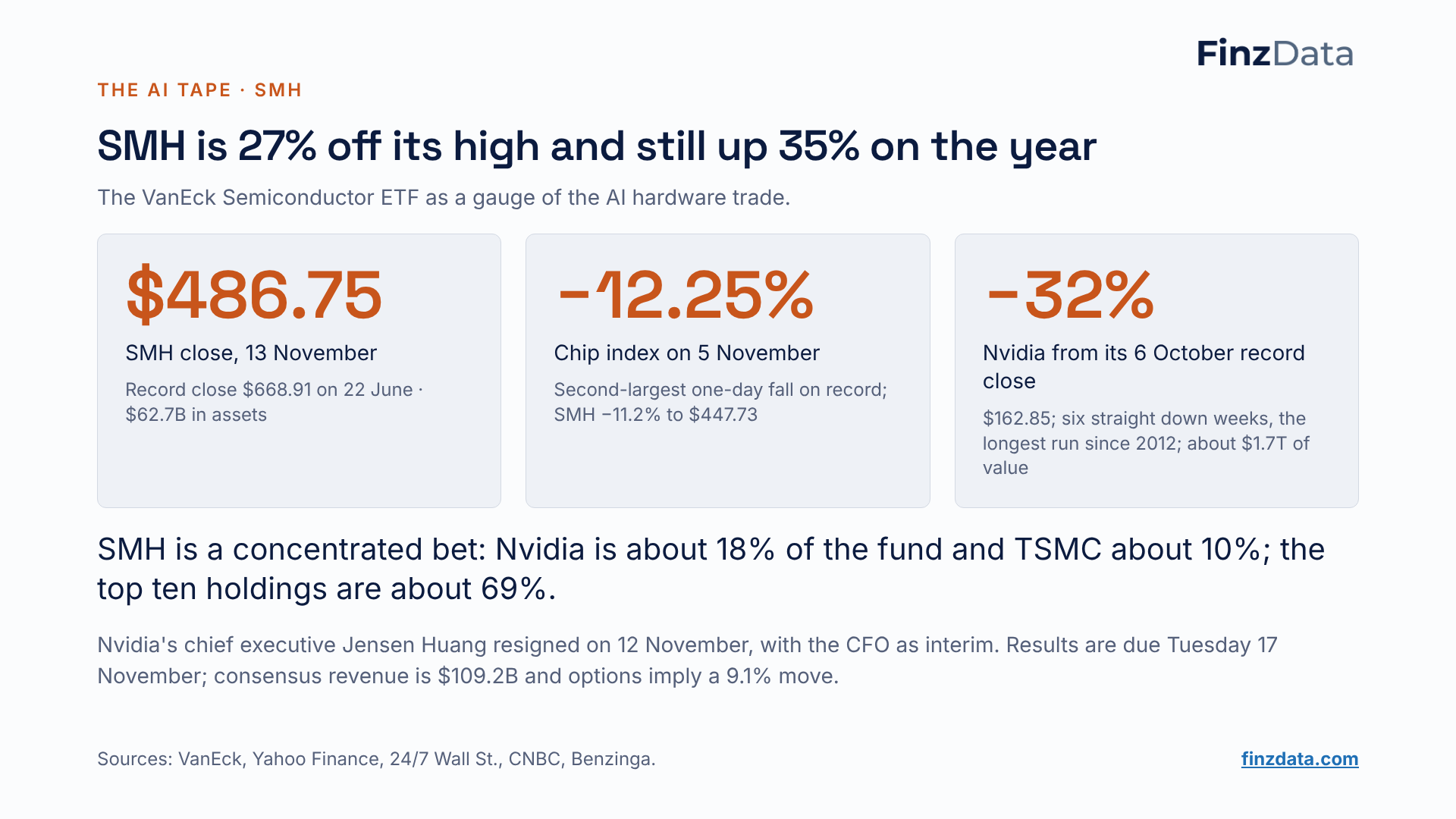
The VanEck Semiconductor ETF as a gauge of the AI hardware trade.
SMH close, 13 November
Chip index on 5 November
Nvidia from its 6 October record close
SMH is a concentrated bet: Nvidia is about 18% of the fund and TSMC about 10%; the top ten holdings are about 69%.
Nvidia's chief executive Jensen Huang resigned on 12 November, with the CFO as interim. Results are due Tuesday 17 November; consensus revenue is $109.2B and options imply a 9.1% move.
Sources: VanEck, Yahoo Finance, 24/7 Wall St., CNBC, Benzinga.
24. Buyers are still showing up; they are choosing different names
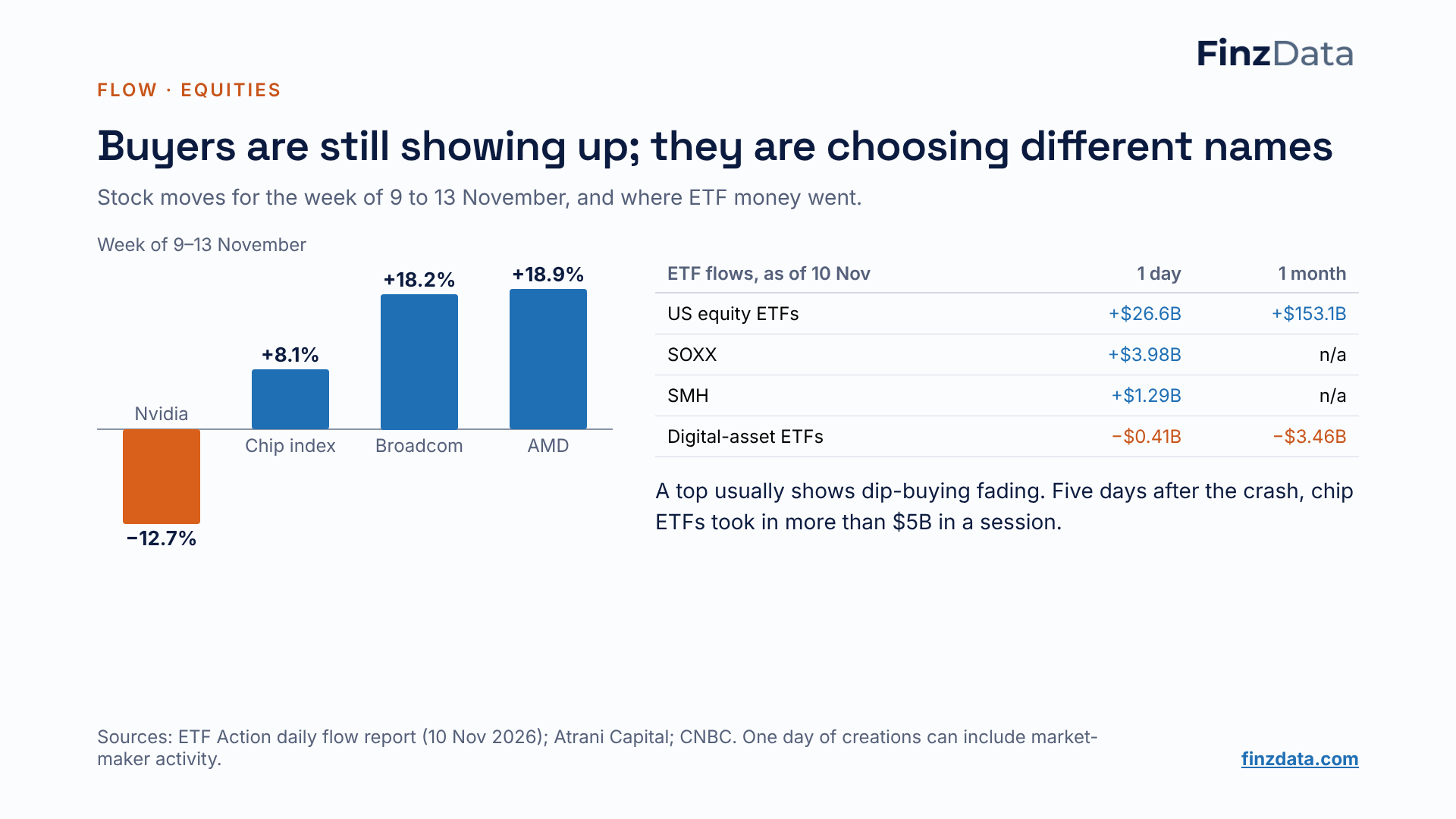
Stock moves for the week of 9 to 13 November, and where ETF money went.
A top usually shows dip-buying fading. Five days after the crash, chip ETFs took in more than $5B in a session.
| ETF flows, as of 10 Nov | 1 day | 1 month |
|---|---|---|
| US equity ETFs | +$26.6B | +$153.1B |
| SOXX | +$3.98B | n/a |
| SMH | +$1.29B | n/a |
| Digital-asset ETFs | −$0.41B | −$3.46B |
Sources: ETF Action daily flow report (10 Nov 2026); Atrani Capital; CNBC. One day of creations can include market-maker activity.
25. Inside SMH, leadership left Nvidia months ago and moved to the bottleneck
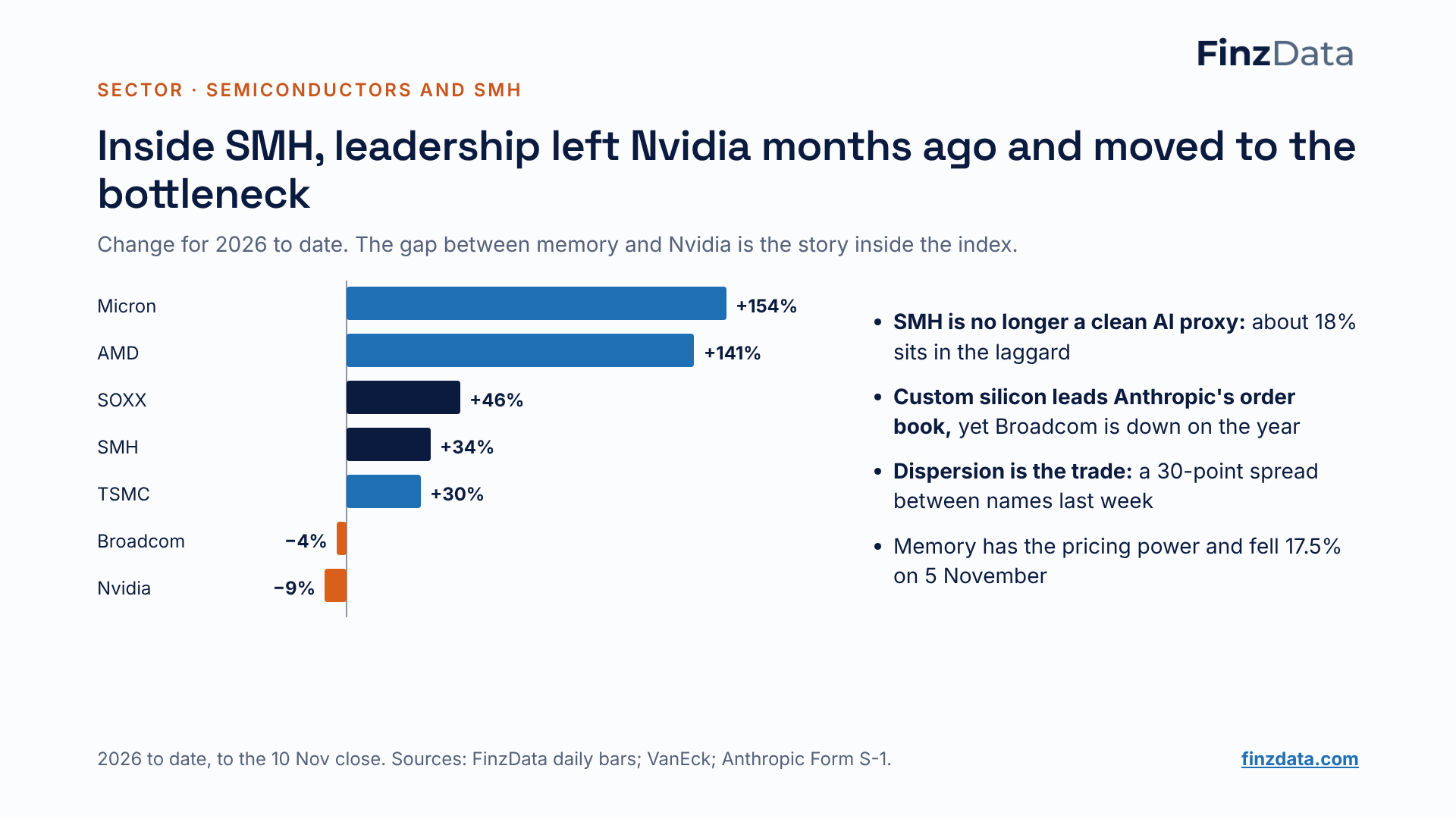
Change for 2026 to date. The gap between memory and Nvidia is the story inside the index.
SMH is no longer a clean AI proxy: about 18% sits in the laggard
Custom silicon leads Anthropic's order book, yet Broadcom is down on the year
Dispersion is the trade: a 30-point spread between names last week
Memory has the pricing power and fell 17.5% on 5 November
2026 to date, to the 10 Nov close. Sources: FinzData daily bars; VanEck; Anthropic Form S-1.
26. Neoclouds: the demand is contracted; the open question is who can finance delivery
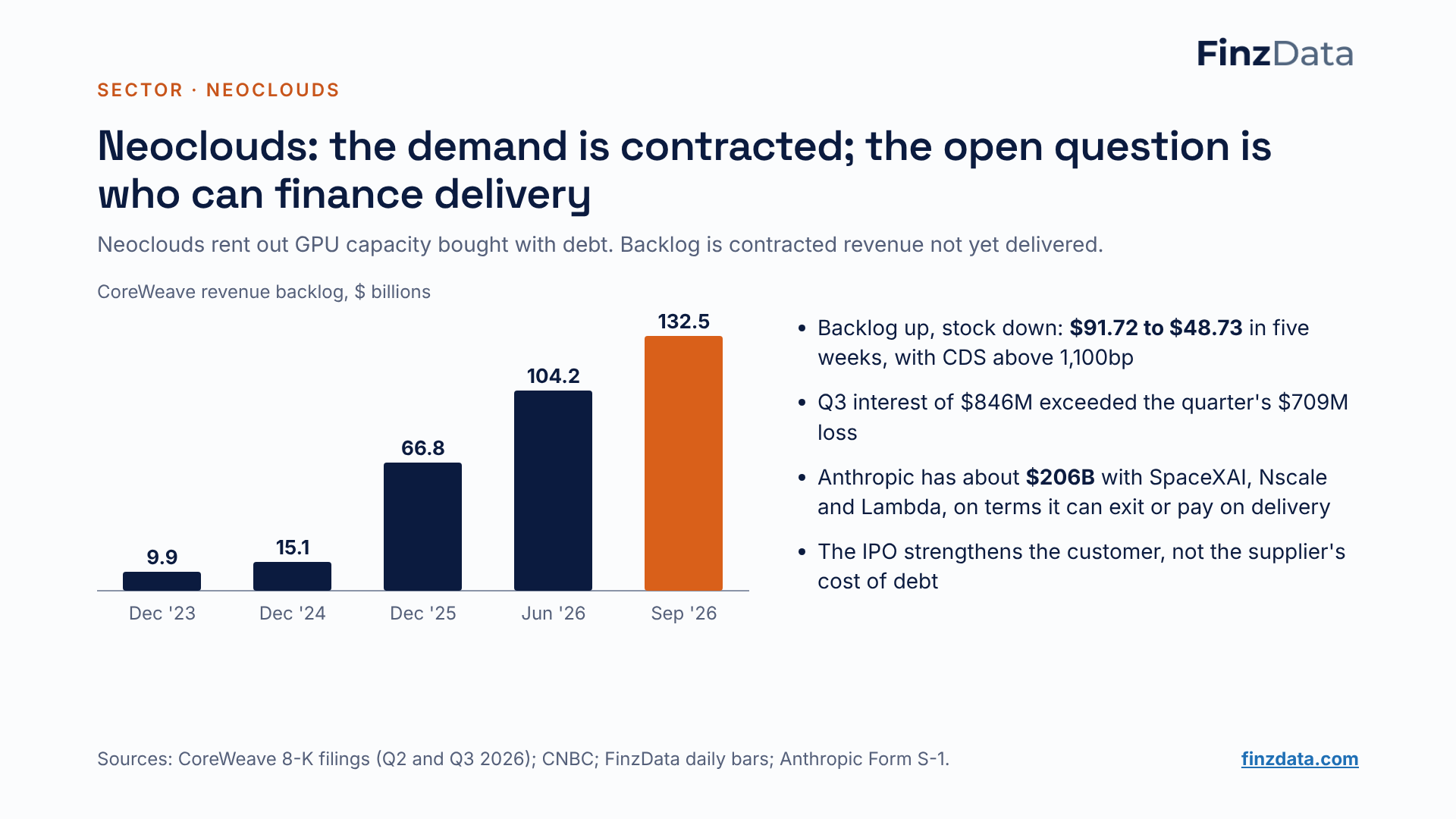
Neoclouds rent out GPU capacity bought with debt. Backlog is contracted revenue not yet delivered.
Backlog up, stock down: $91.72 to $48.73 in five weeks, with CDS above 1,100bp
Q3 interest of $846M exceeded the quarter's $709M loss
Anthropic has about $206B with SpaceXAI, Nscale and Lambda, on terms it can exit or pay on delivery
The IPO strengthens the customer, not the supplier's cost of debt
Sources: CoreWeave 8-K filings (Q2 and Q3 2026); CNBC; FinzData daily bars; Anthropic Form S-1.
27. Hyperscalers are Anthropic's landlords, and three of four now spend more than they earn in cash
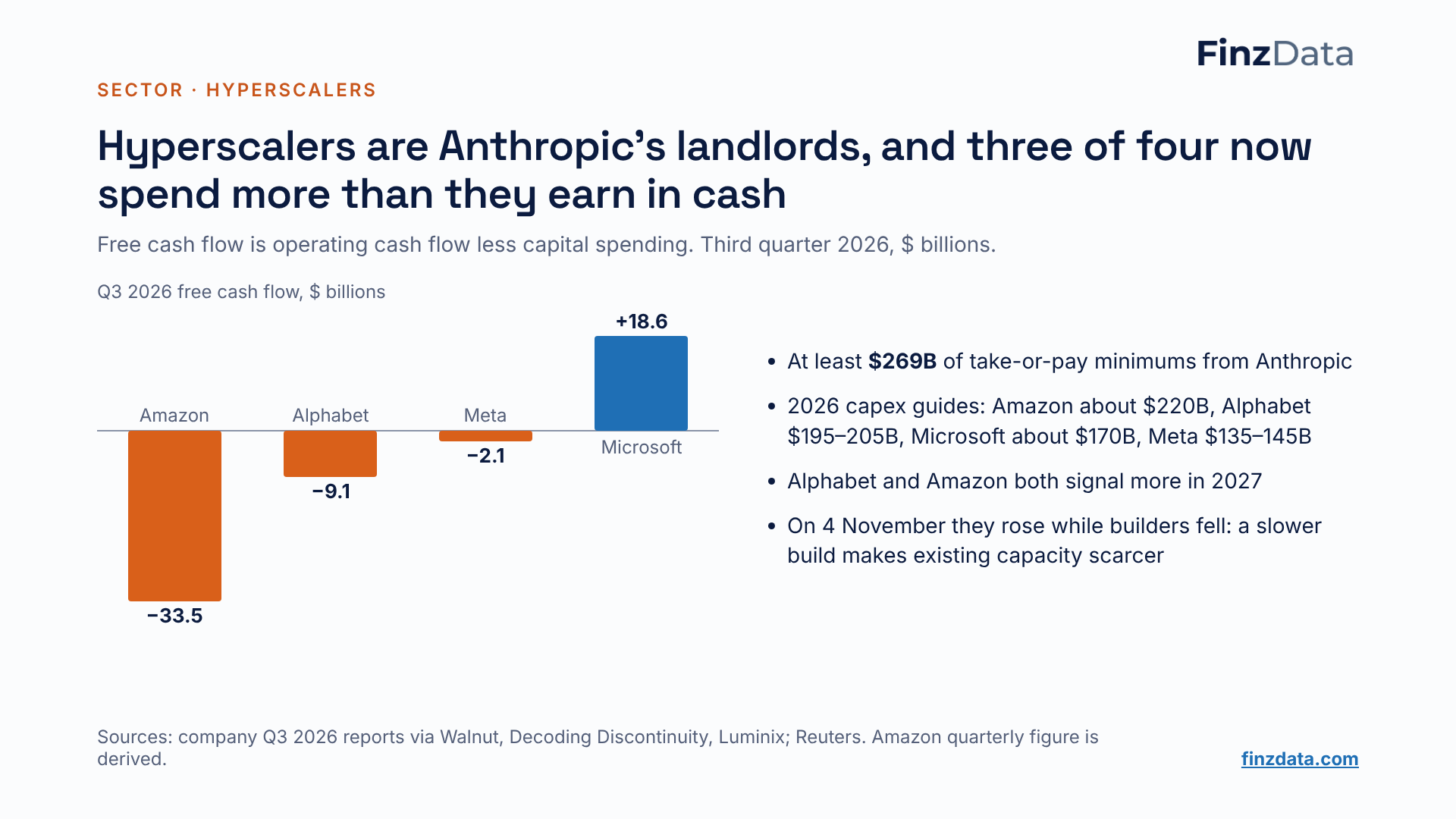
Free cash flow is operating cash flow less capital spending. Third quarter 2026, $ billions.
At least $269B of take-or-pay minimums from Anthropic
2026 capex guides: Amazon about $220B, Alphabet $195–205B, Microsoft about $170B, Meta $135–145B
Alphabet and Amazon both signal more in 2027
On 4 November they rose while builders fell: a slower build makes existing capacity scarcer
Sources: company Q3 2026 reports via Walnut, Decoding Discontinuity, Luminix; Reuters. Amazon quarterly figure is derived.
28. Power: politics repriced the trade in a day; the order books have not slowed
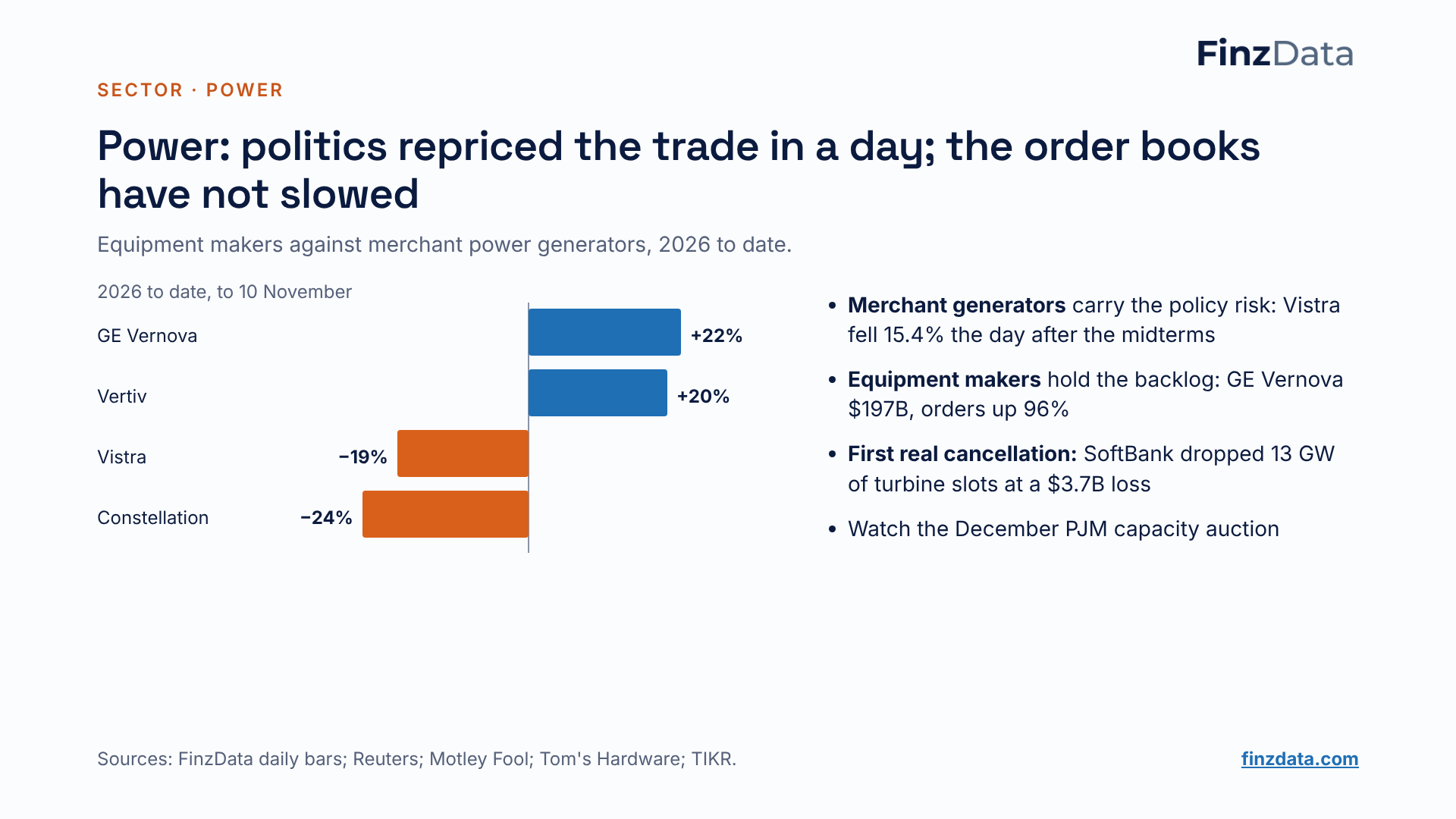
Equipment makers against merchant power generators, 2026 to date.
Merchant generators carry the policy risk: Vistra fell 15.4% the day after the midterms
Equipment makers hold the backlog: GE Vernova $197B, orders up 96%
First real cancellation: SoftBank dropped 13 GW of turbine slots at a $3.7B loss
Watch the December PJM capacity auction
Sources: FinzData daily bars; Reuters; Motley Fool; Tom's Hardware; TIKR.
29. The bottleneck is where the margin goes, and it has moved down the stack
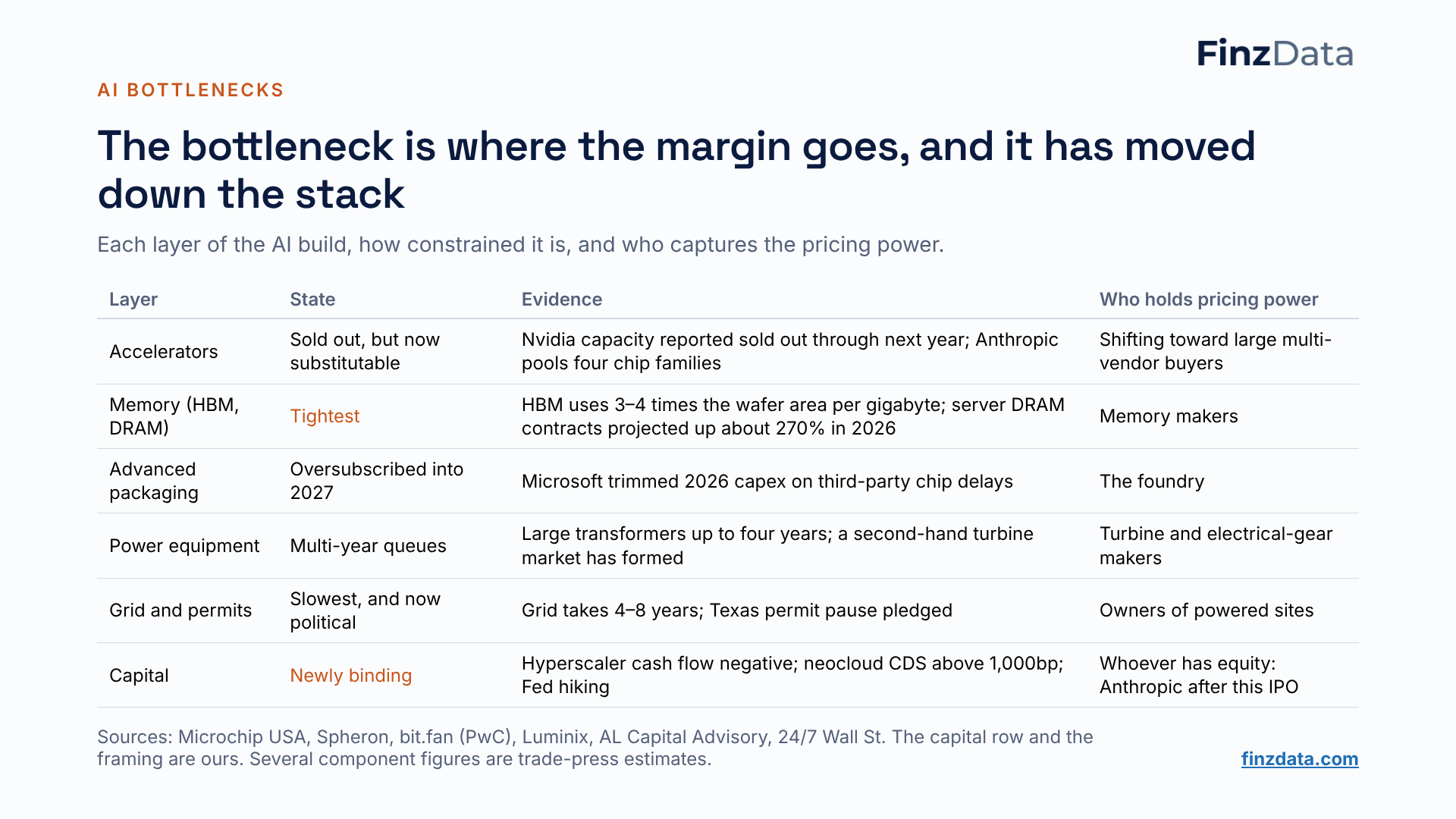
Each layer of the AI build, how constrained it is, and who captures the pricing power.
| Layer | State | Evidence | Who holds pricing power |
|---|---|---|---|
| Accelerators | Sold out, but now substitutable | Nvidia capacity reported sold out through next year; Anthropic pools four chip families | Shifting toward large multi-vendor buyers |
| Memory (HBM, DRAM) | Tightest | HBM uses 3–4 times the wafer area per gigabyte; server DRAM contracts projected up about 270% in 2026 | Memory makers |
| Advanced packaging | Oversubscribed into 2027 | Microsoft trimmed 2026 capex on third-party chip delays | The foundry |
| Power equipment | Multi-year queues | Large transformers up to four years; a second-hand turbine market has formed | Turbine and electrical-gear makers |
| Grid and permits | Slowest, and now political | Grid takes 4–8 years; Texas permit pause pledged | Owners of powered sites |
| Capital | Newly binding | Hyperscaler cash flow negative; neocloud CDS above 1,000bp; Fed hiking | Whoever has equity: Anthropic after this IPO |
Sources: Microchip USA, Spheron, bit.fan (PwC), Luminix, AL Capital Advisory, 24/7 Wall St. The capital row and the framing are ours. Several component figures are trade-press estimates.
30. Seven straight outflow days: $1.91B, most of it from one fund
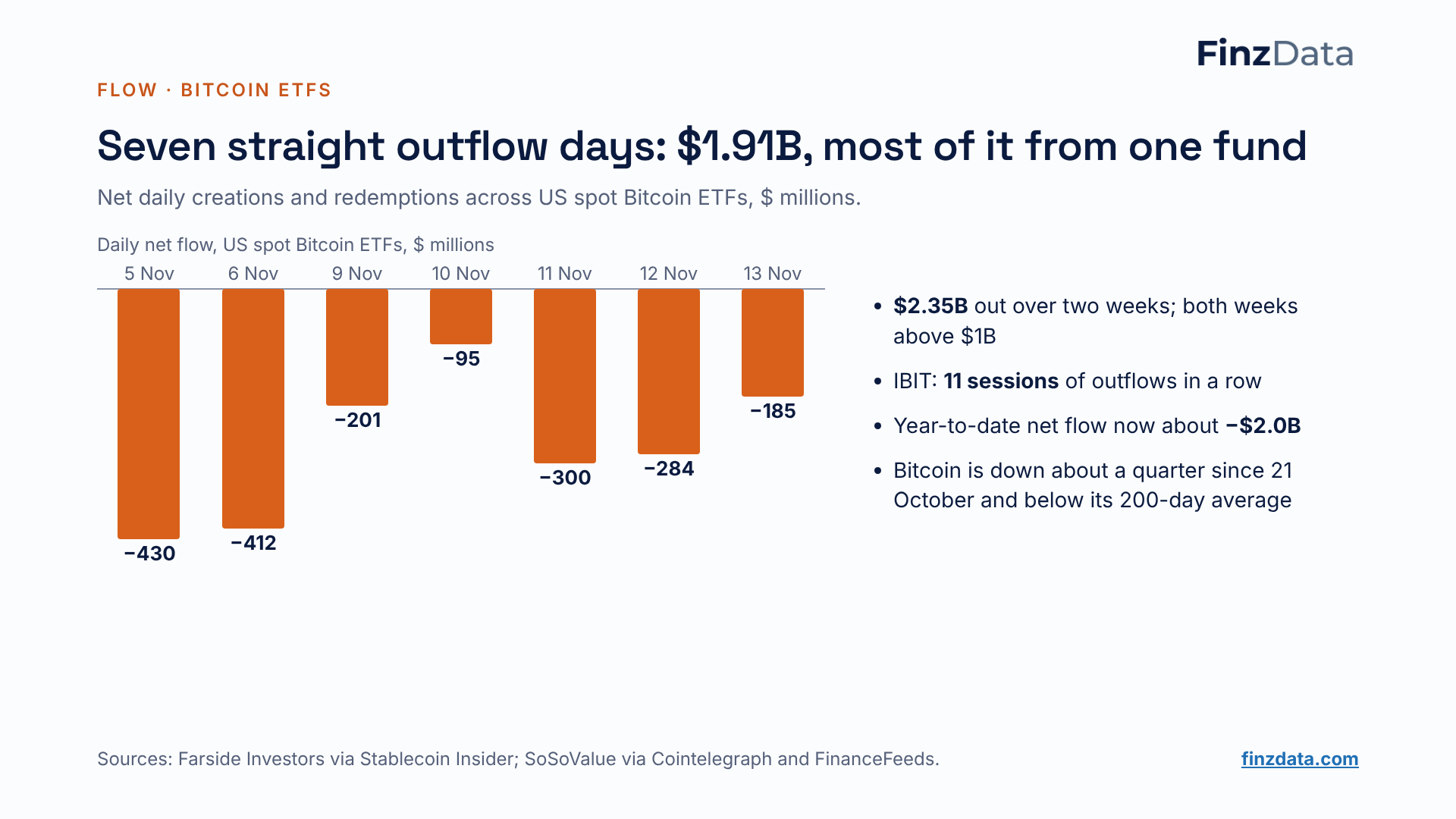
Net daily creations and redemptions across US spot Bitcoin ETFs, $ millions.
$2.35B out over two weeks; both weeks above $1B
IBIT: 11 sessions of outflows in a row
Year-to-date net flow now about −$2.0B
Bitcoin is down about a quarter since 21 October and below its 200-day average
Sources: Farside Investors via Stablecoin Insider; SoSoValue via Cointelegraph and FinanceFeeds.
31. The funding-drain story is tidy, but the sizes point at rates, not the IPO
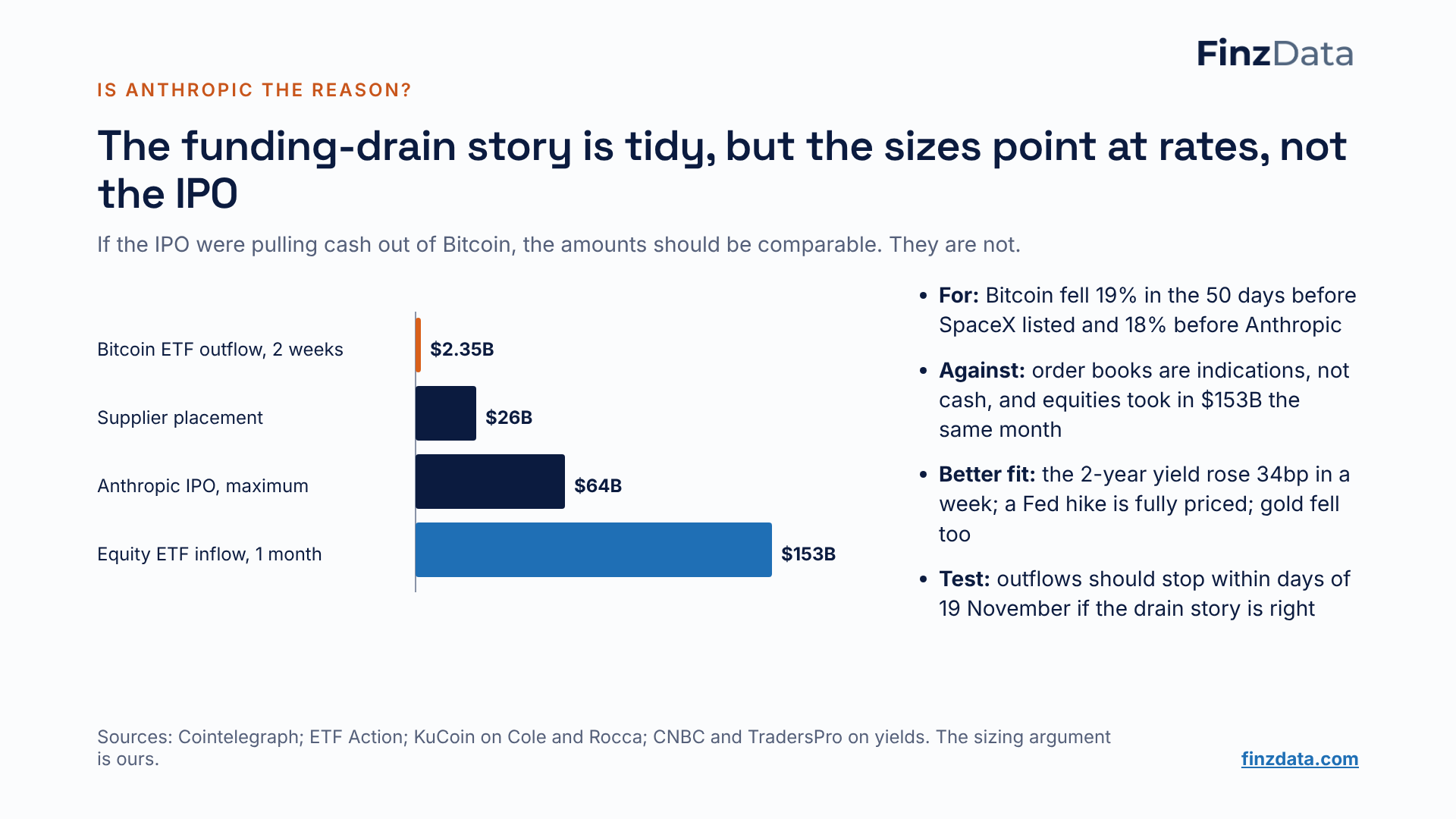
If the IPO were pulling cash out of Bitcoin, the amounts should be comparable. They are not.
For: Bitcoin fell 19% in the 50 days before SpaceX listed and 18% before Anthropic
Against: order books are indications, not cash, and equities took in $153B the same month
Better fit: the 2-year yield rose 34bp in a week; a Fed hike is fully priced; gold fell too
Test: outflows should stop within days of 19 November if the drain story is right
Sources: Cointelegraph; ETF Action; KuCoin on Cole and Rocca; CNBC and TradersPro on yields. The sizing argument is ours.
32. Three paths for the 90 days after listing, and what each means by sector
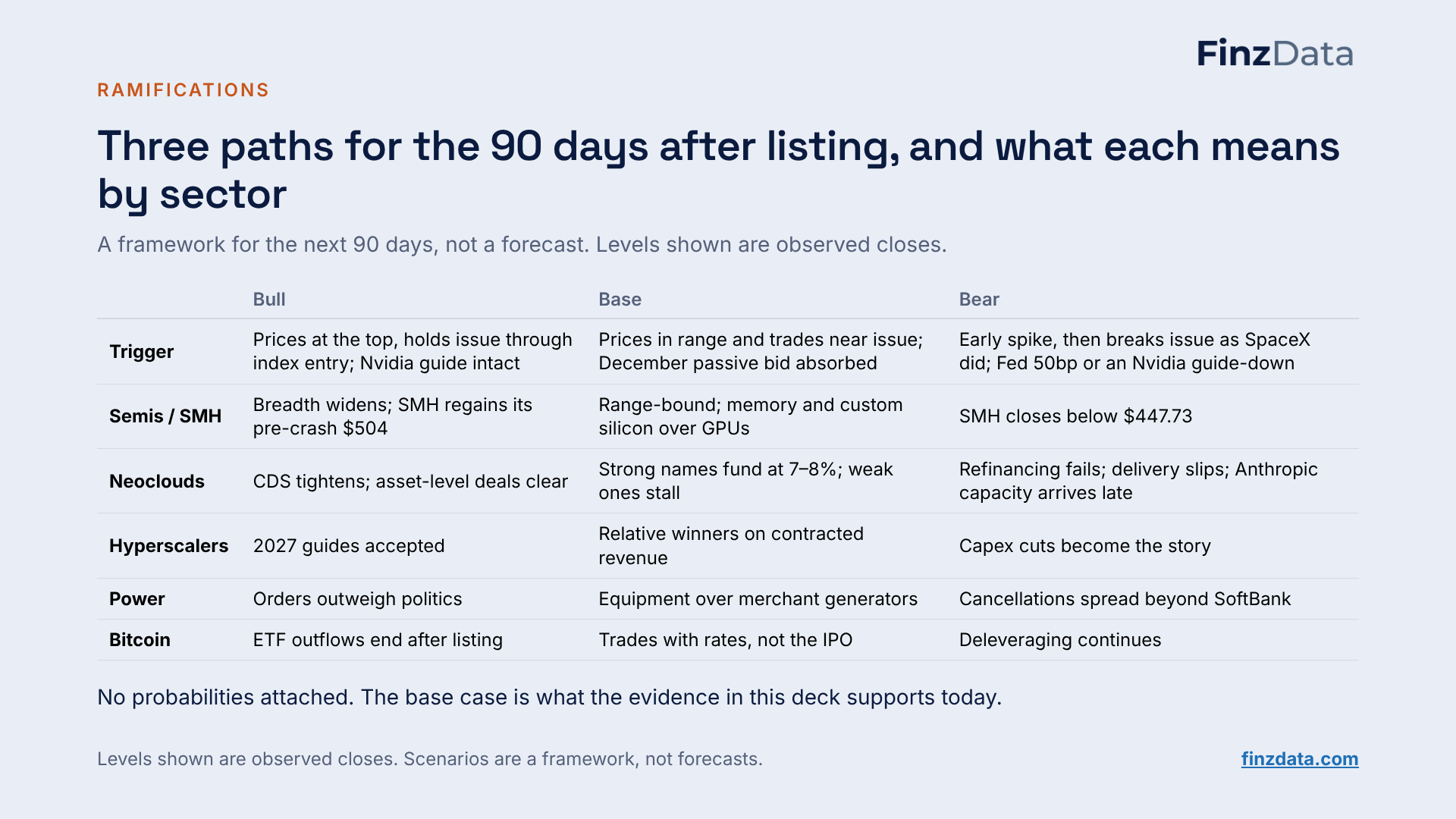
A framework for the next 90 days, not a forecast. Levels shown are observed closes.
No probabilities attached. The base case is what the evidence in this deck supports today.
| Bull | Base | Bear | |
|---|---|---|---|
| Trigger | Prices at the top, holds issue through index entry; Nvidia guide intact | Prices in range and trades near issue; December passive bid absorbed | Early spike, then breaks issue as SpaceX did; Fed 50bp or an Nvidia guide-down |
| Semis / SMH | Breadth widens; SMH regains its pre-crash $504 | Range-bound; memory and custom silicon over GPUs | SMH closes below $447.73 |
| Neoclouds | CDS tightens; asset-level deals clear | Strong names fund at 7–8%; weak ones stall | Refinancing fails; delivery slips; Anthropic capacity arrives late |
| Hyperscalers | 2027 guides accepted | Relative winners on contracted revenue | Capex cuts become the story |
| Power | Orders outweigh politics | Equipment over merchant generators | Cancellations spread beyond SoftBank |
| Bitcoin | ETF outflows end after listing | Trades with rates, not the IPO | Deleveraging continues |
Levels shown are observed closes. Scenarios are a framework, not forecasts.
33. Both cases, on the evidence
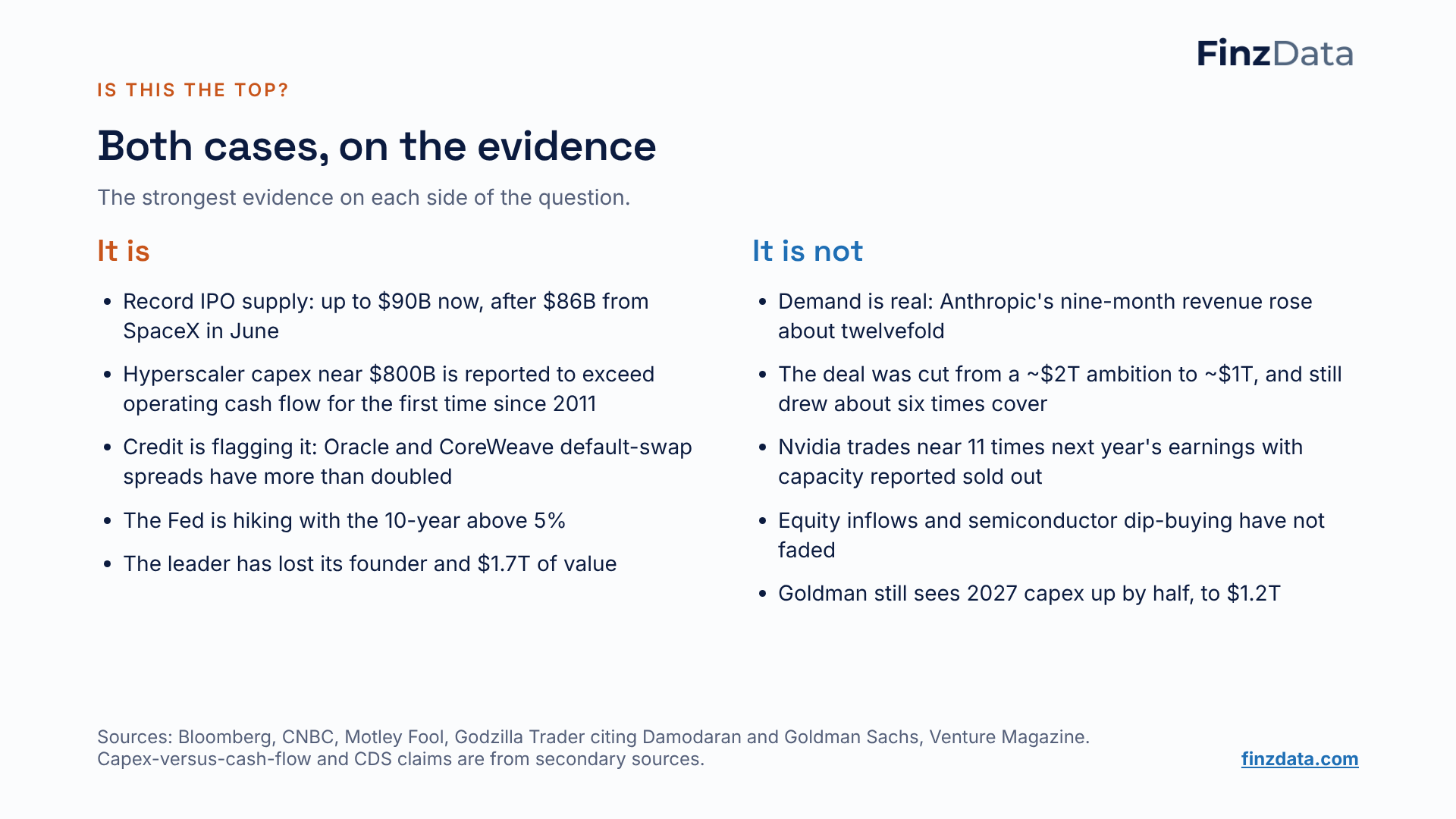
The strongest evidence on each side of the question.
Record IPO supply: up to $90B now, after $86B from SpaceX in June
Hyperscaler capex near $800B is reported to exceed operating cash flow for the first time since 2011
Credit is flagging it: Oracle and CoreWeave default-swap spreads have more than doubled
The Fed is hiking with the 10-year above 5%
The leader has lost its founder and $1.7T of value
Demand is real: Anthropic's nine-month revenue rose about twelvefold
The deal was cut from a ~$2T ambition to ~$1T, and still drew about six times cover
Nvidia trades near 11 times next year's earnings with capacity reported sold out
Equity inflows and semiconductor dip-buying have not faded
Goldman still sees 2027 capex up by half, to $1.2T
Sources: Bloomberg, CNBC, Motley Fool, Godzilla Trader citing Damodaran and Goldman Sachs, Venture Magazine. Capex-versus-cash-flow and CDS claims are from secondary sources.
34. The calendar that settles most of this
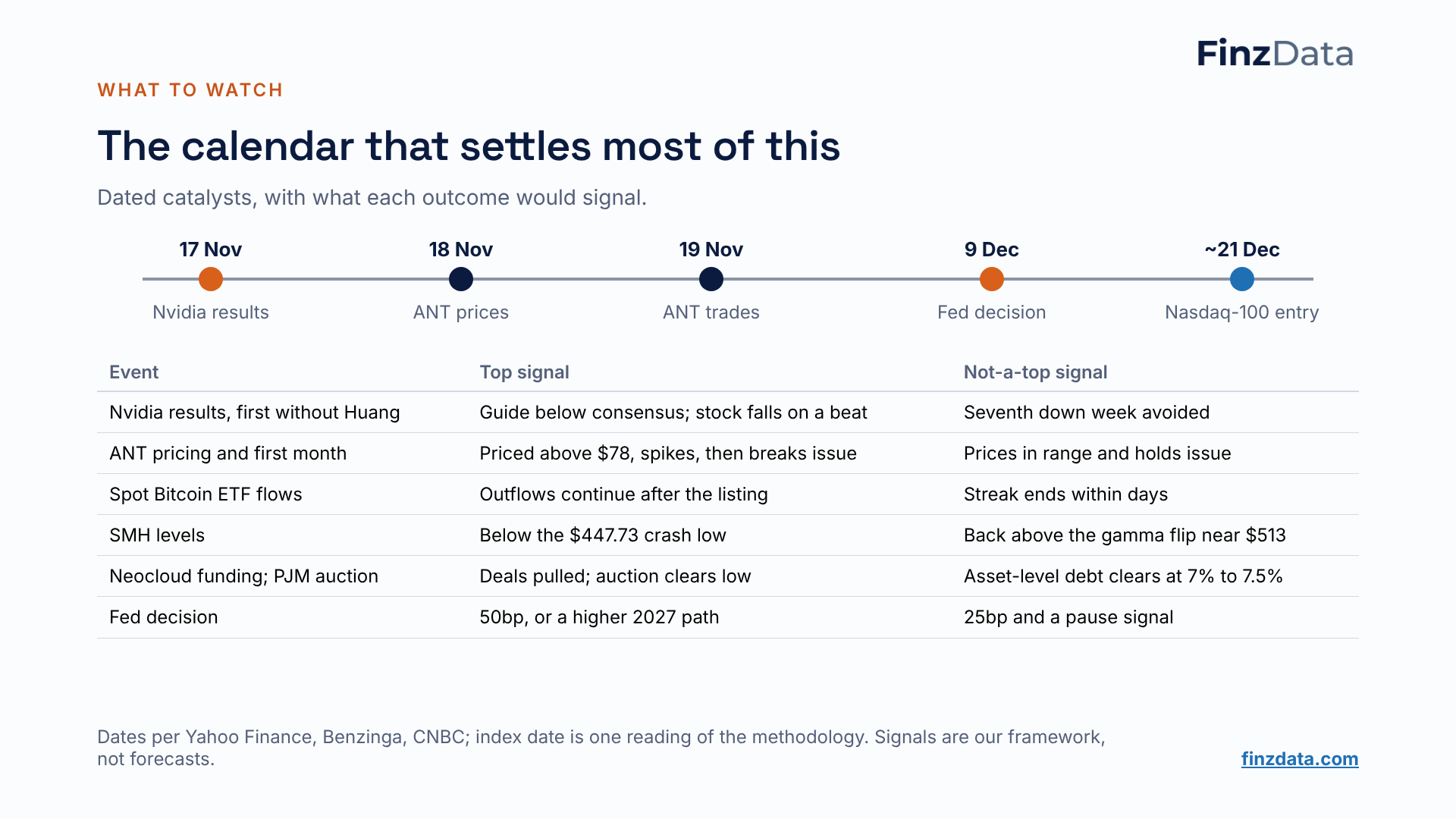
Dated catalysts, with what each outcome would signal.
| Event | Top signal | Not-a-top signal |
|---|---|---|
| Nvidia results, first without Huang | Guide below consensus; stock falls on a beat | Seventh down week avoided |
| ANT pricing and first month | Priced above $78, spikes, then breaks issue | Prices in range and holds issue |
| Spot Bitcoin ETF flows | Outflows continue after the listing | Streak ends within days |
| SMH levels | Below the $447.73 crash low | Back above the gamma flip near $513 |
| Neocloud funding; PJM auction | Deals pulled; auction clears low | Asset-level debt clears at 7% to 7.5% |
| Fed decision | 50bp, or a higher 2027 path | 25bp and a pause signal |
Dates per Yahoo Finance, Benzinga, CNBC; index date is one reading of the methodology. Signals are our framework, not forecasts.
35. Built on FinzData, with the filing as the primary source
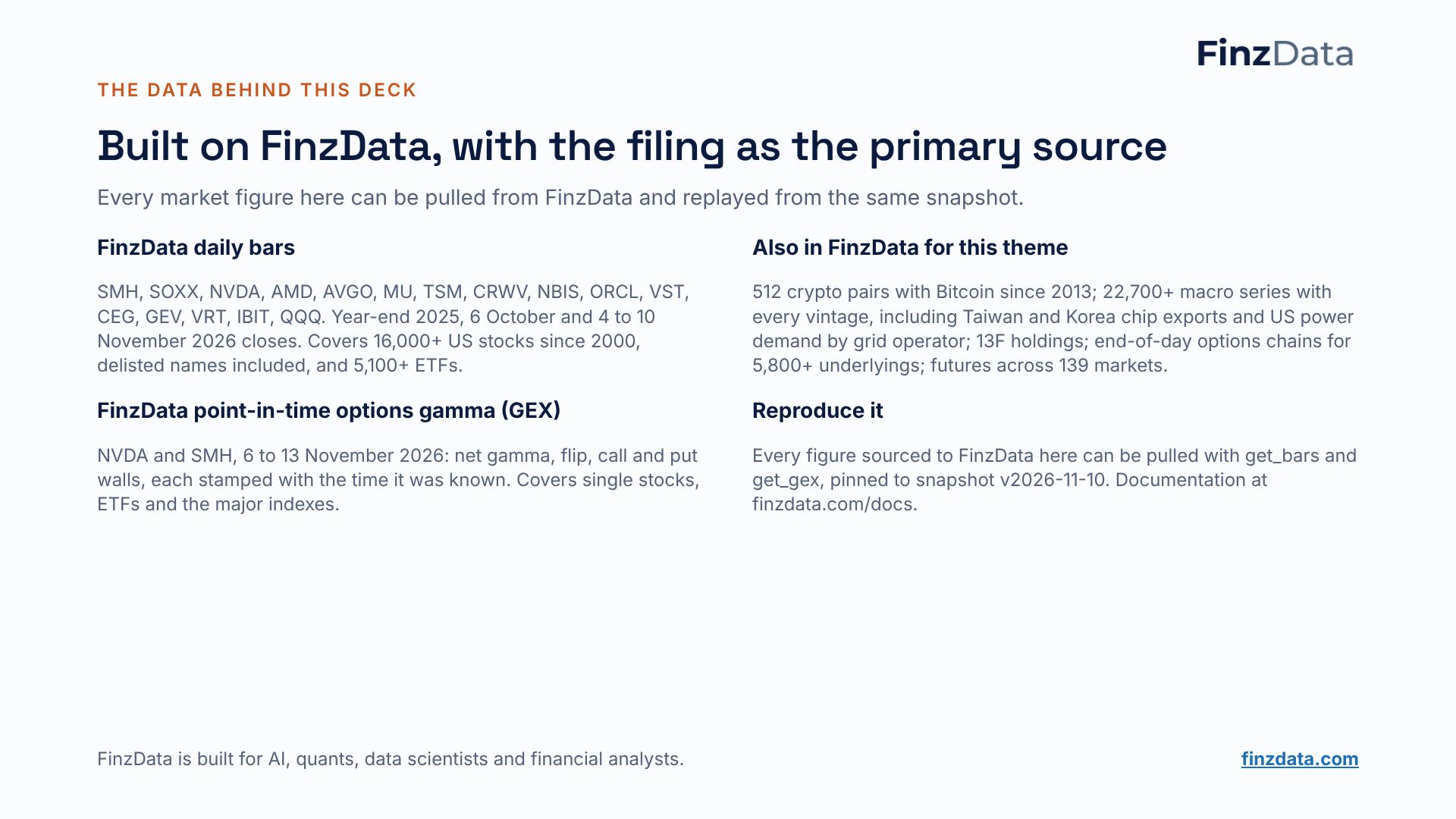
Every market figure here can be pulled from FinzData and replayed from the same snapshot.
FinzData daily bars
FinzData point-in-time options gamma (GEX)
Also in FinzData for this theme
Reproduce it
FinzData is built for AI, quants, data scientists and financial analysts.
36. Where the numbers come from
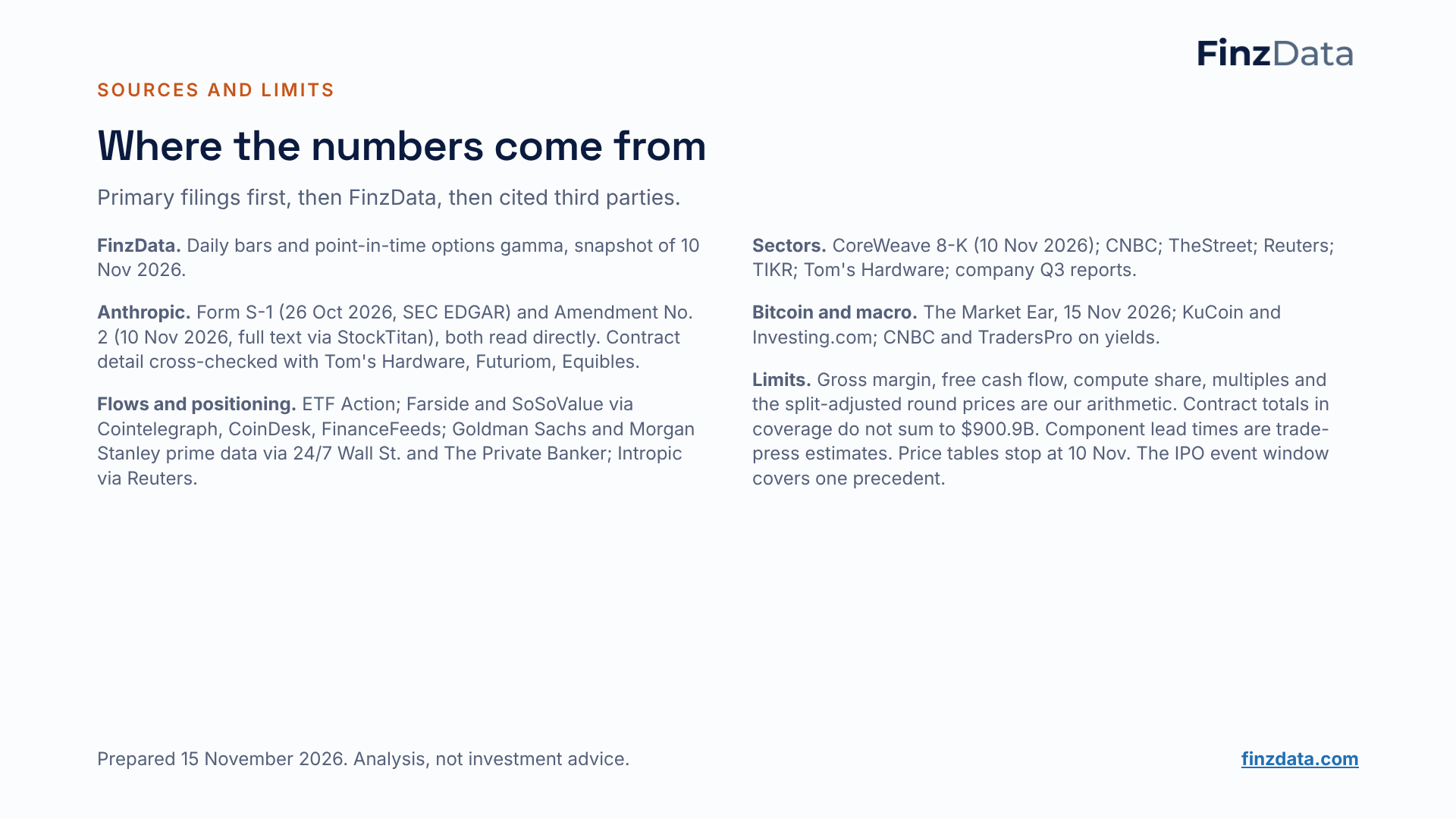
Primary filings first, then FinzData, then cited third parties.
Prepared 15 November 2026. Analysis, not investment advice.
Frequently asked questions
When is the Anthropic IPO?
Anthropic expects to price its IPO on 18 November 2026 and to begin trading on the Nasdaq Global Select Market on 19 November 2026.
What is Anthropic's stock ticker?
Anthropic will trade on Nasdaq under the ticker ANT.
What is the Anthropic IPO price and valuation?
The amended S-1 sets a range of $70 to $78 for 825 million Class A shares, raising up to $64.35 billion. At $78 the company is valued at about $1.02 trillion on shares outstanding and about $1.4 trillion fully diluted.
Is the Anthropic IPO a good investment?
The filing supports both cases. For: nine-month revenue rose about twelvefold, operations generated $6.6 billion of cash in the first nine months of 2026, and at $78 the company prices near 29 times trailing revenue, about a third of SpaceX's multiple at listing. Against: $900.9 billion of committed spend, compute costs back up to 58% of revenue in the third quarter, about 6% of shares floating on day one with staged lock-up releases from day 27, and a Federal Reserve that is raising rates. This is analysis, not investment advice.
How much revenue does Anthropic make?
Revenue was $16,956 million in the third quarter of 2026 and $33.2 billion in the first nine months, against $4.6 billion in all of 2025. Run-rate revenue was about $81 billion at 31 October 2026.
Is Anthropic profitable?
Not on a GAAP basis. The third quarter of 2026 showed a $567 million operating loss and $2.5 billion of adjusted operating income. Operations generated $6.6 billion of cash in the first nine months of 2026.
How much has Anthropic committed to spend on compute?
About $900.9 billion in aggregate, substantially all for compute and infrastructure, with about $70.7 billion due in the twelve months after 30 September 2026 and about $451.6 billion expected before the end of 2030.
How can I buy Anthropic IPO shares?
The filing says up to 20% of the offering may be allocated to retail investors through participating brokers. Reported demand is about six times the shares on offer, so allocations are not guaranteed. This is not investment advice.
When does the Anthropic lock-up expire?
Most holders are locked up for up to 180 days and co-founders and holders above 0.5% for up to 365 days, with staged early releases beginning on the first trading day and at days 27, 48, 62 and 76.
Will Anthropic join the Nasdaq-100?
Nasdaq's fast-entry rule lets a new listing that ranks among the 40 largest index members join after 15 trading days. Nasdaq has not announced a date; one reading of the methodology points to the 21 December 2026 reconstitution.
Is the Anthropic IPO why Bitcoin is falling?
The sizes do not support it as the main cause. US spot Bitcoin ETFs lost $2.35 billion in two weeks while US equity ETFs took in $153 billion in a month, and the 2-year Treasury yield rose 34 basis points in a week as a Fed hike was priced.
Is the Anthropic IPO oversubscribed?
Reported demand is about six times the shares on offer, after the deal was cut from an ambition near $2 trillion to about $1 trillion. Coverage is as reported by the press, not a figure from the filing.
What is Anthropic?
Anthropic is the AI company behind the Claude models. Its S-1 shows 79% of nine-month 2026 revenue from usage-based consumption and 21% from subscriptions, with more than 11,900 customers spending over $100,000 a year.
Download the deck (PDF, 36 slides) More research
Related FinzData research: The AI Unwind: the November 5 selloff, measured · The Yield Curve, the Debt Market and CoreWeave · SPY in short-gamma and long-gamma regimes. Data used here: point-in-time options gamma (GEX) and FinzData daily bars.
Built for AI, quants, data scientists and financial analysts who backtest. Clean data. Real insights. Real alpha. finzdata.com. This material is for information only and is not investment advice. Data sources: FinzData daily bars and point-in-time options gamma, snapshot v2026-11-10; Anthropic Form S-1 (26 Oct 2026) and Amendment No. 2 (10 Nov 2026); CoreWeave 8-K (10 Nov 2026); Menlo Ventures, State of Enterprise AI (Nov 2026); ETF Action, Farside Investors, SoSoValue; Goldman Sachs and Morgan Stanley prime brokerage data as reported.
Get FinzData research free, every morning
The daily brief: what moved, the macro releases that matter, positioning and liquidity, with charts. One email a day, free, unsubscribe anytime.
Topics and related searches
AI infrastructure and data-center capex Semiconductors and AI supply chain Equity strategy and factors Options, gamma and GEX Credit markets and debt Federal Reserve and monetary policy Liquidity, leverage and margin debt
People also search
- when is the anthropic ipo
- what is the anthropic ipo price
- is the anthropic ipo worth buying
- is the anthropic ipo a good investment
- should i buy the anthropic ipo
- how to buy anthropic ipo shares
- is the anthropic ipo oversubscribed
- what is anthropic's valuation
- what is anthropic's stock ticker
- how much revenue does anthropic make
- is anthropic profitable
- when does the anthropic lock-up expire